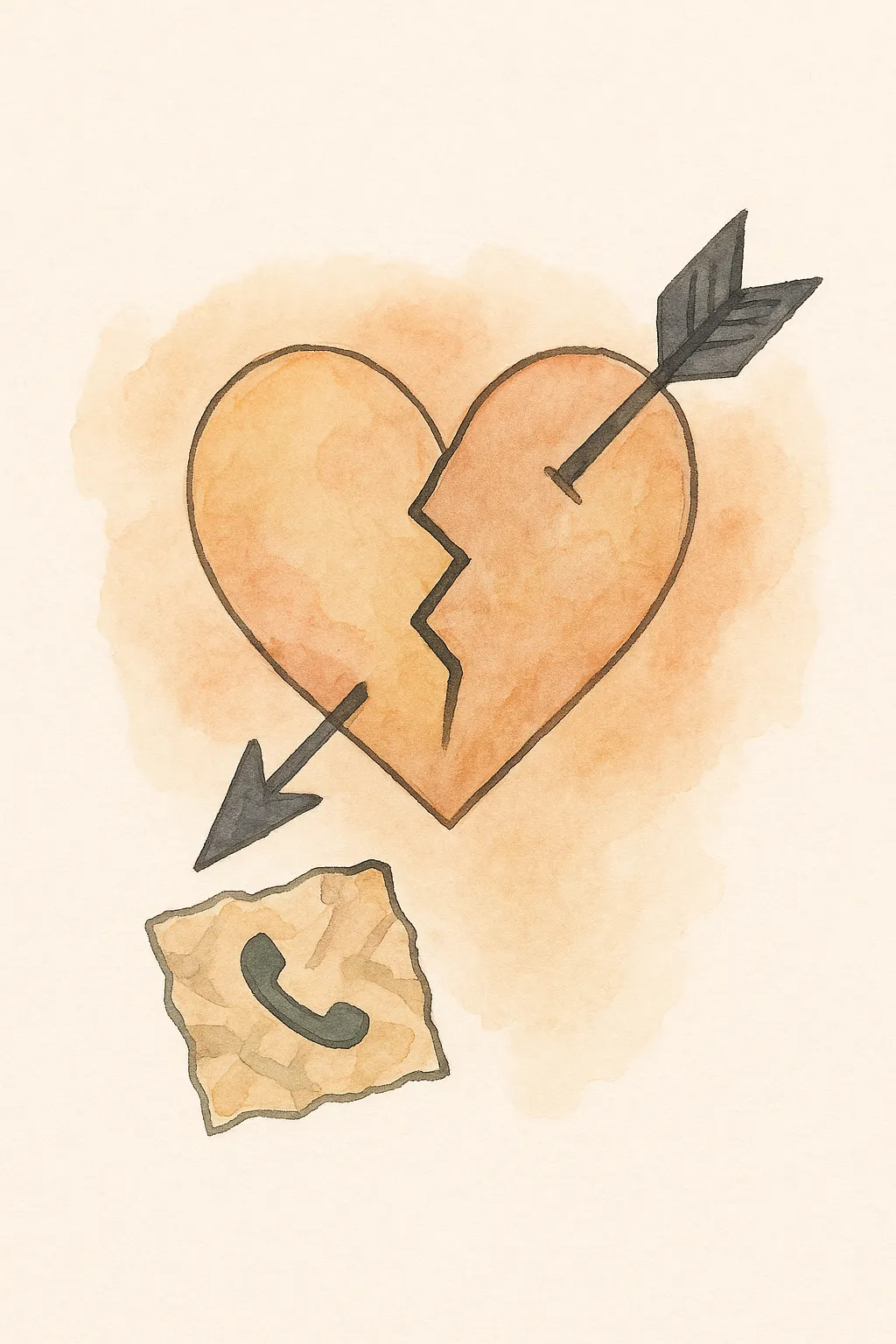
Your nervous system doesn't know the difference between a stranger swiping left and your best friend cutting you out of their life. That's not a metaphor — it's biology. The same threat-detection circuitry fires whether you've known someone for three years or three days. So when a match you'd been texting for a week suddenly goes cold, and you spend the next 48 hours dissecting every message you sent, that response isn't weakness. It's your brain doing exactly what it was built to do — and wildly overestimating the actual danger.
The complication is that most advice treats rejection like a confidence problem. "Believe in yourself more." "Their loss." "You'll find someone better." None of that addresses what's actually happening in your body — the cortisol spike, the social pain response lighting up the same neural regions as physical pain, the way your brain starts pattern-matching to find what went wrong so it can protect you next time. Mindset tips bounce off a nervous system that's already in threat mode.
What you're actually trying to figure out is how to get your system back online — not just feel better in theory, but genuinely reset so you can show up well the next time. That's a learnable process, not a personality trait. And it has specific steps.
The framework that makes this concrete is called The Rejection Reset — three stages that move you from the initial sting to actually being ready again: Feel it, File it, Forward. Not "get over it," not "push through." Three distinct moves, each with a physiological purpose. You'll work through all three before this article is done.
Why Does Rejection Hit So Hard Even When You Barely Knew the Person?
Rejection hurts disproportionately because your brain processes social exclusion as a survival threat. Research from Naomi Eisenberger at UCLA found that social rejection activates the dorsal anterior cingulate cortex — the same region that registers physical pain. Your nervous system isn't being dramatic. It genuinely cannot distinguish between "a date didn't text back" and "I've been cast out of the group."

This is why a rejection from someone you matched with on Tuesday can ruin your Thursday. You barely knew them — logically, it shouldn't matter this much. But logic isn't what's running the show. Your threat system flagged a social rejection, weighted it as significant, and now your brain is running a post-mortem to figure out what you did wrong. That's the overweighting problem: a single data point gets treated like a verdict about who you are.
The evolutionary reason makes sense. For most of human history, being excluded from your social group was genuinely dangerous. Your brain learned to treat rejection as high-stakes information. The problem is that modern dating — where you can be "rejected" by someone who never even met you — generates the same alarm response for something with essentially zero real-world consequence. Your nervous system hasn't updated its software to match the environment.
Understanding this mechanically changes how you relate to the feeling. It's not a sign that you're too sensitive, or that something is actually wrong with you. It's a calibration error — your system fired at full intensity for a situation that warranted maybe 15% of that response. That's useful to know, because calibration is something you can work on. If you've ever wondered why rejection hurts so much even in low-stakes situations, this is exactly the mechanism behind it.
How Does Rejection Actually Rewire Your Confidence — and Can You Speed Up the Reset?
Repeated rejection without a recovery process does accumulate. Each unprocessed hit makes the threat system slightly more sensitive — you start anticipating rejection before it happens, which is how fear of rejection develops into something that shapes your whole approach to dating. The good news is that the nervous system is plastic. You can actively intervene in the reset timeline instead of just waiting it out.
The physiological reset has a few reliable levers. Physical movement — specifically the kind that raises your heart rate — metabolizes the cortisol that rejection triggers. A 20-minute walk isn't a cliché; it's a delivery mechanism for getting stress hormones out of your bloodstream faster. Social connection with people who aren't the person who rejected you also helps, because it gives your threat system evidence that you haven't actually been excluded from your tribe. These aren't "feel good" suggestions — they're interventions at the level where the problem is actually happening.
Cognitive reframing works too, but only after the physiological component has been addressed. Trying to "think your way out" of rejection before your nervous system has had a chance to discharge the stress response is like trying to reason with a fire alarm. The alarm needs to stop first. Once your baseline is lower, reframing — specifically treating the rejection as a data point rather than a verdict — actually lands. This is where the Filing step of the Rejection Reset does its real work: you're not suppressing the feeling, you're reclassifying it from "threat" to "information."
There's also a counter-intuitive finding worth knowing: people who allow themselves to fully feel the sting of rejection for a defined period recover faster than people who immediately try to suppress or reframe it. Suppression keeps the nervous system activated. Feeling it — with a time limit — allows the discharge to complete. If you want a broader framework for navigating this, how to deal with rejection covers the full range of strategies that work at each stage of the process.
What Specific Steps Help You Recover Without Swearing Off Dating Entirely?
This is where the three steps of the Rejection Reset become practical. Feel it means giving the response space — not dramatizing it, not building a story around it, but actually sitting with the physical sensation for a set window. Twenty minutes, maybe. Then it's done. You've felt it; you don't need to keep returning to it.
File it means extracting whatever is actually useful from the experience. Not "what did I do wrong" — that question almost always leads to over-correction and self-blame. The better question is: "Is there anything here that's genuinely actionable?" Sometimes the answer is yes — maybe you pushed for a date too fast, maybe there was a mismatch in communication style you can notice earlier next time. Often the answer is no — they just weren't interested, and that's a compatibility issue, not a performance issue. File the useful stuff; discard the rest.
Run your last rejection through all three steps of the Rejection Reset right now — it takes under five minutes.
- Feel it: Write one sentence describing exactly where you feel the rejection in your body (chest tight, stomach dropped, jaw clenched). Name it physically, not emotionally. This is the "Feel it" step — you're locating the sensation, not analyzing it.
- File it: Write one sentence answering this question honestly — "Is there anything specific and actionable I can take from this, or was this just incompatibility?" If the answer is incompatibility, write that explicitly.
- Forward: Write the next concrete action you'll take in dating — not a vague intention, but a specific one. "I'll reply to one match this week." That's the Forward step.

Forward means taking one small action — not a grand return to dating, but a single low-stakes move that proves to your nervous system that the threat has passed. Sending one message. Updating your profile. Asking someone how their week is going. The size of the action matters less than the fact that you took it, because you're literally giving your brain new data: "I acted, and the world didn't end."
Here's what this looks like in practice. Say you asked someone out after a few weeks of texting and they said they weren't feeling a romantic connection. The Feel it step is letting yourself be disappointed — actually disappointed, not performed disappointment — for a defined window. The File it step is honestly asking whether there's anything useful here. Maybe you realize you'd been unsure about their interest for a while and pushed past your own read of the signals. That's useful. Maybe you did everything right and they just weren't into it. That's also useful — it means nothing to adjust. The Forward step might be as small as opening the app and reading a new match's profile.
Before you read on — what would your "Forward" step actually be right now?
Take 10 seconds. Make it specific. Then keep reading.
If rejection came in the form of being ghosted rather than explicitly turned down, the same three steps apply — but the File it step often needs more work, because there's no clear information to process. In that case, the filing is simpler: "I don't have enough data to know why this happened, so I'm not going to build a story around it." That's a complete and accurate filing.
What Mistakes Turn a Single Rejection Into a Months-Long Slump?
The most common one is autopsy mode — spending days analyzing what you said, how you said it, what you could have done differently — without any actual new information to work with. Your brain is trying to solve a problem, which is adaptive. But when there's no real data, it starts generating explanations from thin air. Those explanations are almost always harsher than reality. "They didn't text back because I was too eager" is a story. "They didn't text back" is the fact.
The second mistake is treating one rejection as a signal about your overall dating prospects. A single data point tells you almost nothing about a pattern. If you've been rejected ten times in a row and each time felt the same way, that might be worth examining — maybe something in your approach to building confidence in dating needs attention. But one rejection from one person who you matched with online is statistically close to meaningless. Your nervous system will try to make it meaningful. That's the calibration error again.
Withdrawing entirely is the third mistake, and it's the one that does the most long-term damage. Every week you spend off the field, the anticipatory anxiety builds. The longer the gap, the more weight each future interaction carries. Approach anxiety compounds in the absence of practice. The Forward step of the Rejection Reset exists specifically to prevent this — keeping the gap small so the re-entry cost stays low.
There's also the mistake of seeking validation from the person who rejected you. Sending a follow-up to ask why, or circling back weeks later to see if they've changed their mind — this keeps your nervous system in an unresolved loop. The rejection was information. You filed it. The loop is closed. Reopening it delays the reset every single time.
How Do You Know When You're Actually Ready to Put Yourself Out There Again?
The honest answer is that waiting until you feel completely ready is usually waiting too long. The nervous system resets through action, not through rest alone. Readiness isn't a feeling that arrives fully formed — it's something you build by taking small steps and noticing that you survived them. If you're waiting to feel zero anxiety before you try again, you're waiting for something that isn't coming.
A more useful signal: you can think about the rejection without it pulling you back into the same emotional intensity. Not "I feel nothing about it" — that's suppression. More like "I remember it, it stings a bit, and I can hold it without it taking over." That's the difference between a processed experience and an unprocessed one. If you're still in the autopsy phase — replaying conversations, checking their profile, wondering what they're doing — the reset isn't complete yet.
Another signal is that you can think about what to say on a first date or how to ask someone out without it feeling like a threat. Not neutral — it's fine if there's some nerves — but not the same threat-level activation that rejection triggered. If asking someone out feels as scary as the rejection felt, the nervous system hasn't reset yet. Give it more time, and keep doing the small Forward steps.
It also helps to notice whether you're approaching the next interaction with curiosity or with a defensive crouch. Curiosity sounds like "I wonder what this person is like." Defensive crouch sounds like "I hope they don't reject me." Both are normal — but if it's mostly crouch, the reset is still in progress. That's not a reason to stop; it's just useful data about where you are. And if fear of rejection is consistently running the show before you even start, that's a separate skill worth developing.
Rejection from someone you know personally — a friend, a coworker — has a longer reset timeline than rejection from a stranger, and that's worth acknowledging. The social complexity is higher, the data is more ambiguous, and the stakes feel real in a way that a dating app rejection doesn't. If you're navigating that specific situation, the same three steps apply, but the Feel it phase legitimately takes longer — and it helps to read up on how to handle being rejected by someone you know before you decide on your next move. Don't rush it.
Rejection isn't a verdict about who you are as a person — it's a data point your nervous system temporarily overweighted. That framing isn't just a mindset trick; it's a more accurate description of what actually happened. One person, at one moment, didn't feel a connection. That's the whole fact. Everything else your brain added to it — the story about what it means, the pattern it's evidence of, the thing it says about your future — that's noise. The Rejection Reset gives you a process for separating the signal from the noise, and doing it faster each time.
The skill here isn't becoming someone who doesn't feel rejection. It's becoming someone who processes it efficiently and gets back to the game without a months-long detour. That's genuinely learnable. Each time you run the three steps — Feel it, File it, Forward — the timeline shortens. Your nervous system learns that rejection isn't the end of the loop; it's just a step in it. And once that's calibrated, the whole experience of putting yourself out there changes. Not because rejection stops happening, but because it stops costing so much.