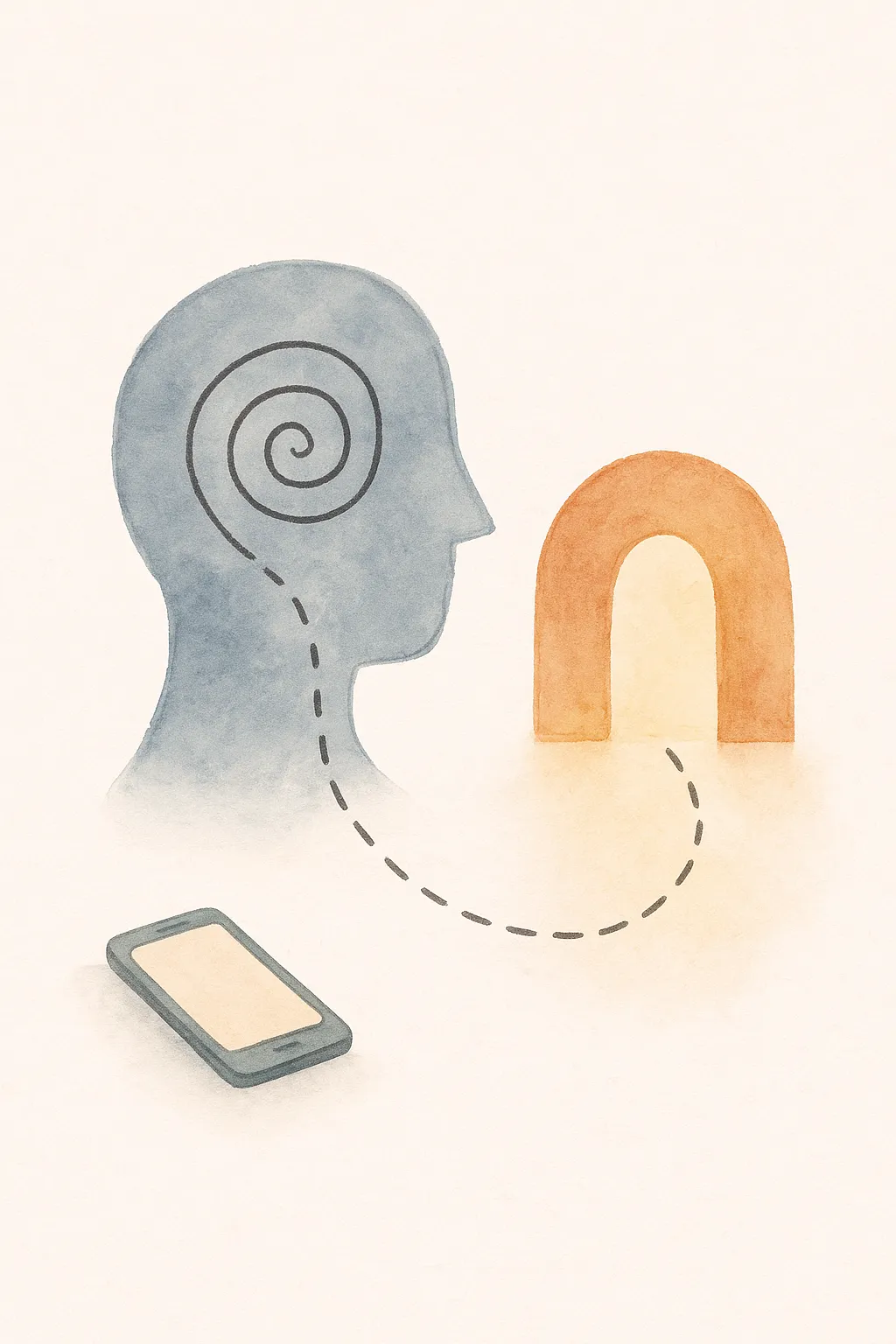
You're standing at the bar, drink in hand, and someone across the room catches your eye. They glance back. The moment is right there — open, alive, practically lit up with possibility. And then you spend forty-five seconds debating whether to go over, and by the time you decide yes, they've turned back to their friends and the whole thing has sealed shut like it never existed.
What's frustrating is that you probably weren't paralyzed by shyness. You might be perfectly comfortable in meetings, at parties, in conversations with strangers on planes. The bar felt different because bars are high-context environments — everyone is performing a version of themselves, everyone is half-watching the room, and the social stakes feel public in a way that a one-on-one conversation doesn't. But here's what nobody tells you: the approach itself is almost the easy part. The hard part is learning to read whether a window is actually open before you walk through it.
That skill — context-reading as a trained perceptual ability — is what separates people who approach confidently from people who either freeze or barrel in at the wrong moment. This article teaches you both: how to read the room, and what to do once you see the opening.
Why Does Approaching Someone at a Bar Feel So High-Stakes Even When You're Socially Confident Elsewhere?
Bars compress social feedback into a very small space and a very short time. You're not just talking to one person — you're potentially performing in front of their friends, nearby strangers, and the bartender who has seen everything. The approach feels high-stakes because the perceived audience is large and rejection feels public.
Even when nobody is actually watching. Which, most of the time, they aren't.

This is a well-documented psychological pattern: people consistently overestimate how much others notice and judge their social missteps. Researchers call it the spotlight effect, and it runs hot in bar environments specifically because the noise, the lighting, and the social density all signal "you are being observed." Your nervous system doesn't know the difference between a real audience and an imagined one.
The other factor is that bars have no built-in conversational scaffold. At work, you have a shared project. At a party, you have a mutual friend. At a bar, you're walking into a social situation with no obvious reason to be there except that you want to talk to this person — which is, ironically, the most honest social move you can make, and somehow the one that feels most exposed.
Understanding how to overcome approach anxiety in general is useful background, but bar-specific anxiety has its own texture. It's less about fear of rejection in the abstract and more about the perceived lack of control over context. You can't script the setting. That's actually useful information, because it means the skill to build isn't bravado — it's perceptual. Learn to read the room, and the stakes drop dramatically.
How Do You Read the Room Before You Ever Say a Word?
Context-reading is a trainable skill, and like most trainable skills, it starts with knowing what to look for. Before you approach someone you like, you're looking for three things: body orientation, group dynamics, and micro-availability signals.
Body orientation is the most reliable signal. Someone who is interested in their immediate social environment — open to input from outside their group — tends to face outward. Their feet point away from the cluster they're in. They make eye contact with the room rather than just with the people they arrived with. Someone who is physically closed — shoulders angled inward, body turned fully toward their group, gaze rarely lifting — is in a sealed social bubble. That doesn't mean they're unfriendly; it means the window isn't open right now.
Group dynamics matter because you're rarely approaching someone in isolation. If they're in a group of two having an intense conversation, the window is probably closed. If they're in a larger group with loose, scattered attention — people drifting in and out of sub-conversations — there's natural porousness there. A person standing slightly at the edge of their group, holding their drink, scanning the room? That's a textbook open window.
Micro-availability signals are subtler: a second glance after the first, a slight smile that wasn't directed at anyone specific, a pause in their conversation where they look up. These aren't guarantees — they're data points. The skill is in accumulating a few of them before you move, not in waiting for certainty (certainty doesn't exist). This is exactly the kind of scenario the Practice mode in Dating Coach is built for — drilling your pattern recognition until reading these signals becomes fast and automatic rather than a conscious checklist.
One concrete example: you notice someone at the end of the bar who has ordered a drink and is now waiting, glancing around the room. They're alone for the moment, their posture is open, and they've made brief eye contact with you twice. That's not a coincidence. That's a window. The question is whether you act inside it.
What Does a Low-Pressure Bar Approach Actually Look Like in Practice?
The best bar approaches don't look like approaches. They look like two people who happened to end up in the same conversational space and found something to talk about. The goal isn't to deliver a line — it's to create a moment of genuine contact that the other person can choose to extend or not.
Proximity first, words second. Move to a natural position near them — ordering a drink, waiting for the bartender, standing near the same area — before you say anything. This removes the "I walked all the way over here specifically to talk to you" energy, which can feel pressuring even when it's well-intentioned. Once you're nearby, a short, low-stakes observation is all you need to open. Knowing how to talk to someone you don't know comes down to exactly this: a simple, situational comment that gives them an easy way in.
Notice what that opener isn't: a compliment, a question about whether they come here often, or anything that signals "I am now attempting to attract you." It's just a normal human observation. The conversation can grow from there or not — and that's fine either way.
This is where The Approach Window becomes practically useful. The window opens when you notice the signals — the eye contact, the open body language, the pause in their conversation. Neuroscience research on action initiation suggests that if you don't move within about three seconds of deciding to act, your brain starts generating reasons not to. The internal monologue kicks in. You start auditing your opening line. The moment closes. Acting inside the window isn't about being impulsive; it's about not giving your threat-detection system time to veto a decision you've already made.
Before you read on — think of a specific bar or social setting you're likely to be in this week. What would an open window look like there?
Take 10 seconds to picture the actual signals: where the person is standing, what their body language looks like, what the natural opening would be. Then keep reading.
For starting a conversation with someone you like in a bar specifically, the content of what you say matters far less than the tone. Relaxed, curious, not outcome-dependent. You're not auditioning. You're just talking.
The next time you're in a bar or any social venue, practice identifying Approach Windows without acting on them — just to train your perception.
- Spend the first 10 minutes of arriving doing nothing but observing: who is facing outward, who is scanning the room, who is at the edge of their group with loose attention.
- Pick one person and track their signals for 60 seconds — count how many open-window indicators you spot (eye contact, outward posture, conversational pause).
- The next time you're out, do the same exercise but commit to entering one window you identify within 3 seconds of deciding to act.

What Are the Signals That the Window Has Closed — and How Do You Avoid Misreading Them?
Closed windows get misread in both directions. Some people push forward when the signals are clearly off; others interpret a brief distraction as rejection and retreat before anything has actually happened. Both errors are worth understanding.
A window that has closed looks like this: they've turned fully back into their group, the conversation there has picked back up, their body language is inward. If you approach in this moment, you're not walking into a conversation — you're interrupting one. That's not fatal, but it raises the social cost of the interaction unnecessarily. Better to wait, or to let it go and look for the next window.
The more common misread is treating a neutral response as a closed window. Someone who gives you a short answer isn't necessarily uninterested — they might just be calibrating. Bars are noisy, people get caught off guard, and not everyone is immediately warm. A single one-word answer isn't a signal to leave; it's a signal to give the conversation one more easy beat and see what happens. Approaching without awkwardness often means being comfortable with a brief silence or a short response without immediately spiraling into "they don't like me."
What you're actually watching for is a sustained pattern, not a single data point. Two or three consecutive closed signals — body turning away, monosyllabic answers, attention clearly elsewhere — that's a closed window. One short answer in a loud bar is just a short answer in a loud bar. The skill of reading attraction signals in person is partly about not catastrophizing neutral data.
The other misread worth naming: confusing your own anxiety for their disinterest. If you're feeling exposed and awkward, you'll sometimes project that onto the other person and interpret their normal behavior as coldness. This is why training your perception in low-stakes moments — the exercise above — matters. The more you've practiced reading actual signals, the less you'll fill in the gaps with your own fear.
How Do You Know If You're Ready to Approach or Just Waiting for a Courage That Won't Come?
There's a version of "getting ready" that is actually just waiting. You tell yourself you'll approach when you feel more confident, when you've had another drink, when the moment is more obviously right. That moment tends not to arrive, because the brain is very good at generating reasons to stay safe.
Readiness, in the context of approaching someone, is a myth in the same way that "feeling ready" to give a speech or start a difficult conversation is a myth. Building confidence in dating doesn't happen in the abstract — it happens through small, repeated acts of doing the thing before you feel fully ready. The approach itself is the practice. There is no preparatory exercise that substitutes for it.
What you can do is lower the stakes of any individual approach by reframing what success means. If success means "they become interested in me," the stakes are high and you're dependent on their response. If success means "I identified a window and walked through it within three seconds," the stakes are entirely within your control. That reframe is not just a mindset trick — it's how skill development actually works. You can't control outcomes; you can control execution.
The Approach Window framework is useful here precisely because it gives you a concrete, executable action: spot the window, act within three seconds. That's it. You're not trying to be charming or impressive or smooth. You're just practicing entering the window. Everything after that is a bonus. For a deeper look at what's happening underneath the hesitation, understanding why rejection feels so scary can help you separate the real risk (low) from the perceived risk (enormous).
One practical test: if you've been watching someone for more than five minutes and haven't moved, you're not waiting for the right moment. You're waiting for certainty. And certainty, in social situations, doesn't exist. The window you're waiting for is the one you're currently in. Flirting in person starts with the decision to be in the room with someone, not the perfect thing to say once you get there.
The exercise is simple: next time you're out, identify one window — just one — and commit to entering it before you've finished deciding whether you're ready. Notice what happens. Not to the other person, but to you. That noticing is the beginning of the skill.
Most people who are good at approaching didn't start out confident. They started out willing to be uncomfortable, repeatedly, until the discomfort shrank to a manageable size. That's the whole mechanism. Getting better at talking to people you're attracted to is a function of volume and reflection, not personality. Part of what makes this easier over time is learning how to express interest without seeming desperate — so that when you do enter the window, the energy you bring is genuinely relaxed rather than performed.
The thing that changes when you practice context-reading isn't that you stop feeling nervous — it's that the nervousness stops being the most important information in the room. You start noticing the actual signals instead of your own internal noise. The bar stops being a high-stakes arena and starts being a place with windows that open and close, and you're getting better at seeing them.
That shift — from self-focused to context-focused — is the real skill. And once you have it, you'll find it applies well beyond bars. Every social environment has windows. You're just learning to see them.