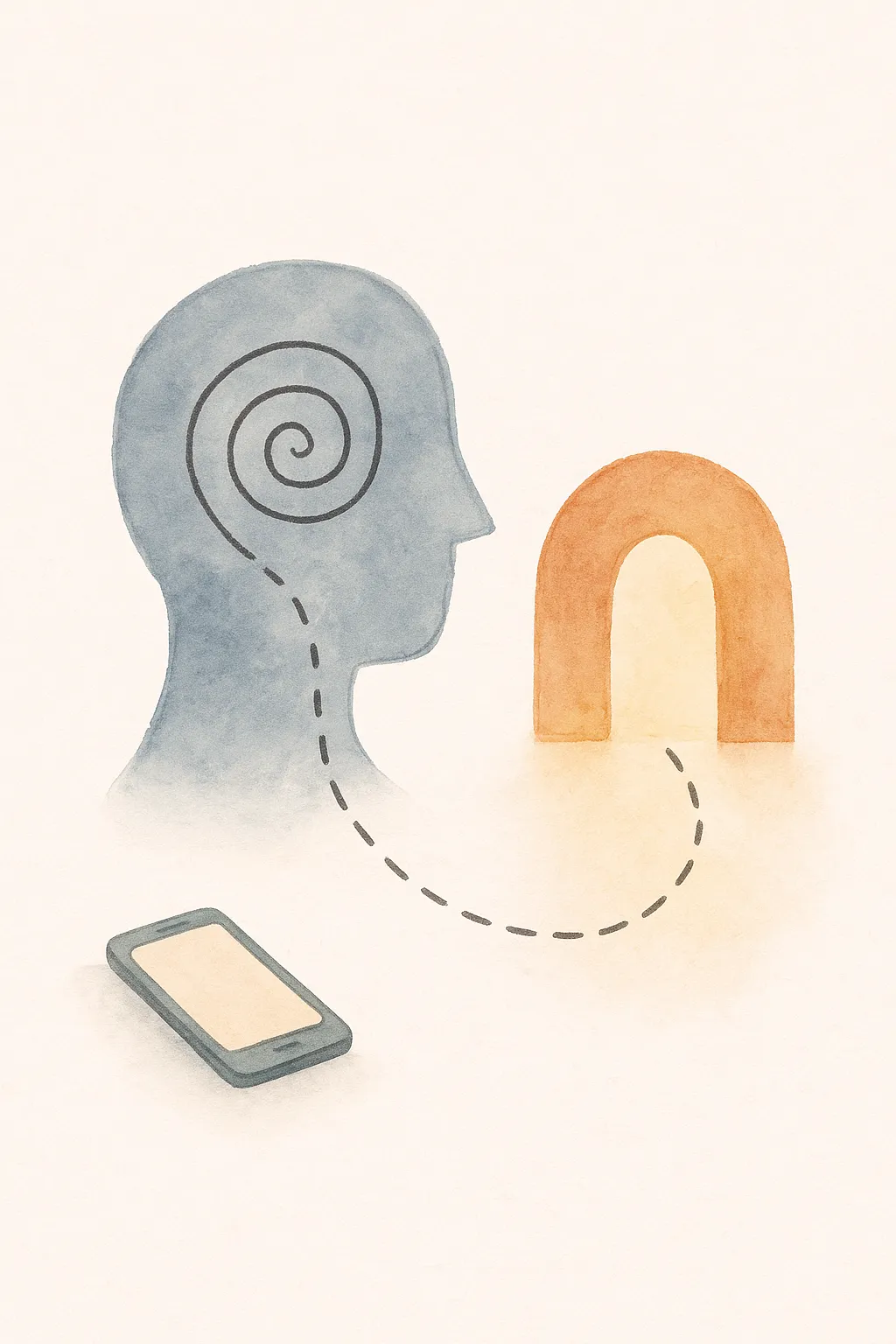
You matched with someone last Tuesday. They seem interesting. You've opened the app three times since then, typed something, deleted it, and closed it again. Not because you don't know what to say — you're a functional adult who talks to people every day. But something about this specific context makes your brain go completely blank and your standards for your own sentences go through the roof.
Here's what's actually happening: you're treating confidence as a prerequisite. Like you need to feel confident first, and then you'll send the message. But that's backwards. Confidence isn't something you summon before you act — it's something that gets built by acting, seeing what happens, and adjusting. Nobody teaches this. That's why it feels like a personality flaw when it's really just a skills gap.
So the real question isn't "how do I become a more confident person?" It's "what's the smallest thing I can practice right now that starts building it?" That's what this article is about — a specific, repeatable way to get there.
Why Does Dating Feel So Much Harder When Your Confidence Is Low?
Dating feels harder with low confidence because low confidence triggers avoidance, and avoidance prevents the practice that builds skill, which keeps confidence low. It's a loop — just running in the wrong direction. The less you try, the less data you have, the more uncertain you feel, the less you try.
A lot of people assume they're bad at dating because they're awkward or boring or "just not that type." But when you look closer, what's usually happening is that they've had very few reps. Dating is genuinely a skill set — reading signals, starting a conversation, knowing what to say on a first date, recovering from rejection without spiraling. None of these are innate. They're practiced. And if you haven't had many chances to practice, of course they feel hard.
Low confidence also distorts your perception of risk. When you're not sure of yourself, a one-word reply feels like a verdict on your entire personality. You start catastrophizing: they're not interested, you said something wrong, this always happens. The emotional volume gets turned way up on normal, low-stakes interactions. That distortion makes it harder to read situations clearly and harder to stay in the game long enough to actually learn anything.
There's also the comparison trap. You watch someone else talk easily to a stranger at a party and assume they were born that way. They weren't. They've just had more reps — or they've made peace with the discomfort in a way that looks effortless from the outside. The gap between you and them is practice, not personality. If you want to understand what that process actually looks like, how to be more confident breaks down the mechanics behind it.
How Does the Confidence Loop Turn Small Dating Skills Into Self-Belief Over Time?
The Confidence Loop works like this: you pick a specific skill, you practice it, something goes reasonably well (a win — even a small one), and that win feeds your confidence. Then you practice again from a slightly higher baseline. Confidence is the output of this loop, not the input. You don't need it to start. You need a skill to work on.
The key word is "small." Most people try to build dating confidence by doing the scariest thing — asking out the person they're most intimidated by, or going on a date when they're already anxious and underprepared. That's like trying to build a fitness habit by signing up for a marathon. The loop breaks before it starts because the first step is too big to complete successfully. Small wins are what compound. A decent opening message. A follow-up question that lands. A moment on a date where you made someone laugh.
Here's a concrete example. Say your skill focus this week is keeping a conversation going past the first exchange. You practice it — maybe on a low-stakes match, maybe with someone you already know. It goes okay. Not perfect, but okay. That "okay" is a data point that rewires the story you're telling yourself. Over time, those data points stack up and start to feel like evidence. Evidence that you can do this. That's confidence — built from the inside out, not performed from the outside in.
The loop also works in reverse when you understand it. If your confidence dips after a rough week of dating, you don't need a pep talk. You need to identify which skill broke down and practice it deliberately. That's a completely different — and much more actionable — response to feeling bad about yourself in dating.
What Is the One Dating Skill You Can Actually Practice Today?
The best skill to start with is the one right before the part where you freeze. For most people, that's either starting the conversation or responding when a conversation goes quiet. Both are learnable. Both give you immediate feedback. And both are small enough to practice in a single sitting.
Take opening messages. Most people overthink them to the point of paralysis — trying to be clever, original, and low-pressure all at once. The skill isn't coming up with something brilliant. It's sending something genuine that invites a response. That's it. If you're struggling with what to say to someone you like, the practice isn't to think harder — it's to send more messages and notice which ones actually get conversations going. The same applies when you're figuring out how to talk to your crush in person — the goal is the same: something genuine that opens a door.
Before you read on — what would YOU write here?
Someone's profile mentions they just got back from a solo trip to Japan. Take 10 seconds to draft an opening message. Then compare with the example below.
If the conversation is your sticking point, the skill to practice is asking one follow-up question per reply — not two, not zero. Just one. It keeps things moving without feeling like an interrogation. You can practice this anywhere: with friends, with colleagues, on any low-stakes match. The skill transfers. This is exactly the kind of scenario the practice mode in Dating Coach is built for — you get to run the rep without the real stakes attached.
Pick one conversation skill from the Confidence Loop to run as a deliberate practice rep today.
- Choose a specific skill: opening message, follow-up question, or recovering from a one-word reply.
- Find one real or practice conversation to try it in — send the message, ask the question, or write the reply you'd normally overthink and delete.
- After, write one sentence about what happened — not whether it "worked," but what you noticed. That noticing is the loop turning.

Should You Wait Until You Feel Confident Before Putting Yourself Out There?
No — and not because of some motivational "feel the fear and do it anyway" logic. It's more mechanical than that. Waiting to feel confident before acting is like waiting to feel warm before turning on the heater. The feeling follows the action. It doesn't precede it.
A lot of people put dating on hold because they want to "work on themselves" first. Sometimes that's genuinely useful — if you're in a rough patch and need to stabilize, that's real. But often it's a sophisticated form of avoidance. The idea that you'll wake up one day feeling ready, and then you'll start. That day doesn't tend to arrive on its own. What arrives instead is another six months of the same loop, just with better self-awareness about why you're not doing it.
The confidence you're waiting for gets built by doing the thing you're waiting to feel confident enough to do. That's the whole loop. You can start it at any point — imperfect, slightly nervous, with a mediocre opening message. If approach anxiety is the specific wall you keep hitting, the answer isn't to wait until it disappears. It's to make the first step small enough that the anxiety doesn't have enough surface area to stop you.
There's also a useful reframe here: you don't need to be confident in dating generally. You just need to be confident in the next specific skill. Asking someone out feels huge as a concept. As a skill — one sentence, one moment — it's much more manageable. Break it down that far, and the waiting stops making sense. If shyness is part of what's keeping you stuck, how to stop being shy in dating gets into the specific patterns that keep people in that holding pattern and how to work through them.
How Do You Know When Your Confidence in Dating Is Genuinely Growing?
The clearest sign isn't that you stop feeling nervous. It's that the nervousness stops stopping you. You still feel it, but it has less veto power over your behavior. That's a real shift, and it usually shows up quietly — you notice you sent the message without agonizing over it for twenty minutes, or you asked someone out and felt okay regardless of the answer.
Another marker: your recovery time gets shorter. Early in the loop, a rejection or a ghost can knock you sideways for days. As the loop builds, you have more data to draw on — more evidence that this is a normal part of dating, not a verdict on you specifically. If you've been bouncing back from rejection faster than you used to, that's the Confidence Loop working. You're not more numb — you're more grounded. Part of what makes that shift possible is how to stop caring about rejection in a healthy way — not by becoming indifferent, but by building enough evidence that a single no doesn't define the whole picture.
You also start reading situations more accurately. Low confidence makes you over-interpret everything — a slow reply means they hate you, a short message means they're pulling away. As confidence builds, you develop better calibration. You can look at signs that someone is actually interested without immediately second-guessing what you see. That's not overconfidence — it's just clearer signal processing.
Watch for the moment when you start thinking about what you want from a date, not just whether they'll like you. That mental shift — from "am I good enough?" to "is this a good fit?" — is one of the most reliable indicators that something real has changed. It doesn't mean you've arrived anywhere. It means the loop is running in the right direction.
If you're not sure whether you're growing, go back to a skill you practiced three weeks ago. Stopping the text spiral, handling a conversation that goes quiet, reading whether a date went well — do any of those feel even slightly less heavy than they used to? That's your data. Growth in this area rarely feels dramatic. It mostly feels like things that used to be a big deal quietly becoming less of one.
Confidence in dating isn't a state you reach. It's a direction you move in — and the Confidence Loop is what keeps you moving. Identify one skill. Practice it. Notice the small win. Let that win feed the next rep. That's the whole thing.
The person who's good at dating isn't someone who never feels uncertain. They're someone who has run enough reps that uncertainty doesn't derail them. You build that by starting — not by waiting to feel ready, not by overhauling your personality, but by picking one small skill and practicing it today. Do that consistently, and in six weeks you won't recognize the gap between where you started and where you are. Not because you became a different person. Because you built something real.