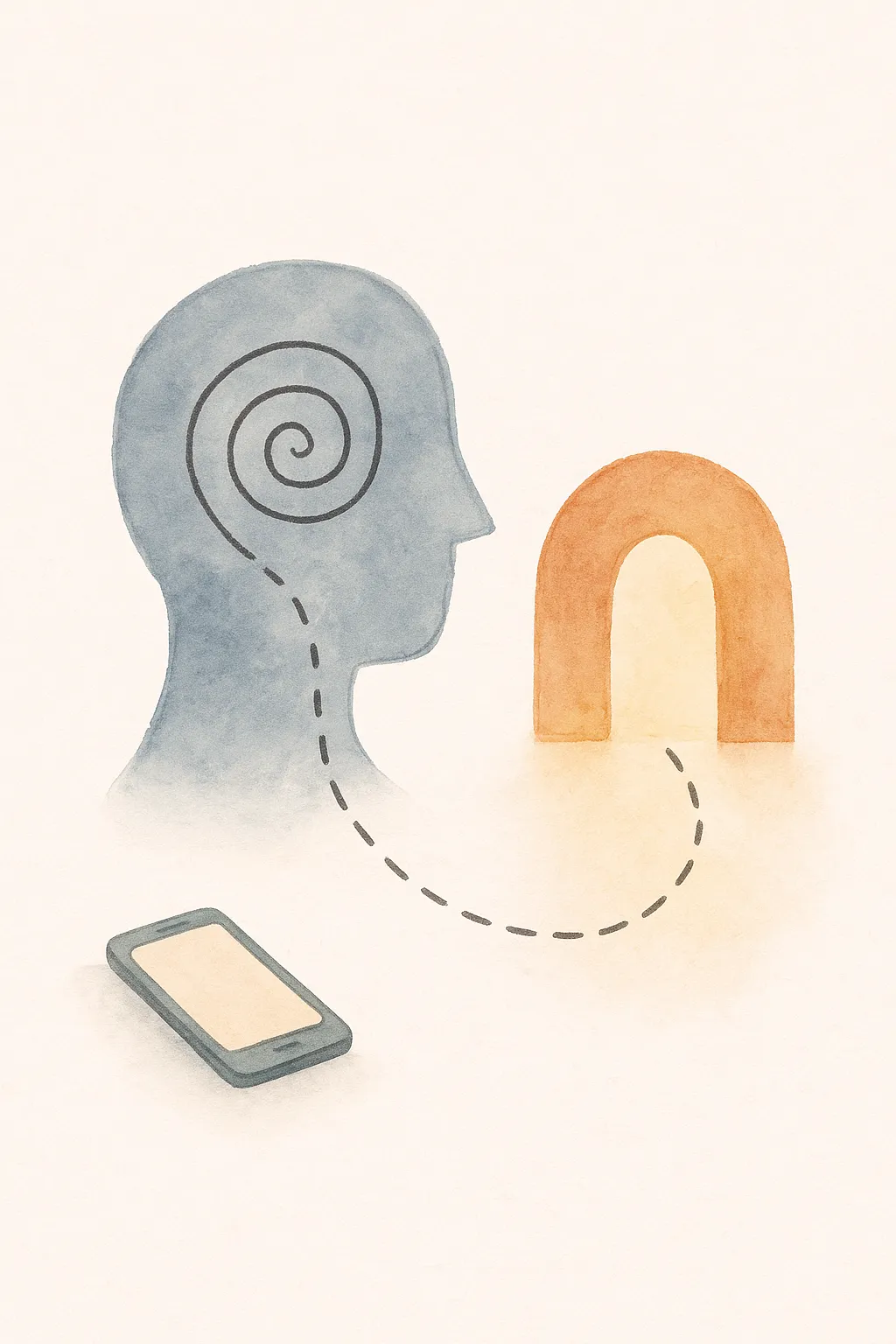
You're standing outside a bar, hovering over someone's profile, or about to type a message to someone you actually like — and you freeze. Not because you don't know what to say. Because some part of your brain is waiting for a feeling that hasn't arrived yet. A feeling of readiness.
Here's the trap: most people treat confidence as a prerequisite. Something you need to have before you act. So they wait — reading more articles, rehearsing more scenarios — in search of that internal green light. But the green light never comes from waiting. It comes from doing something small and surviving it. That's not a motivational poster. That's literally how the brain updates its threat assessment.
So the real question isn't "how do I become a confident person?" It's: what's the smallest action that creates internal proof? That proof is what confidence actually is — and this article is going to show you exactly how to generate it.
The framework that makes this click is called the Confidence Loop. It works like this: you build a skill, you practice that skill, you get a small win, and confidence is what comes out the other side. Confidence is the output of that loop — not the entry fee. Once you see it that way, the whole game changes. You stop waiting to feel ready and start asking: which part of this loop can I actually work on right now?
Why Does Confidence Feel Like Something You Either Have or You Don't?
Confidence feels fixed because nobody teaches it as a skill. You see someone walk into a room and own it, or watch someone ask for a number without flinching, and your brain files that under "they're just like that." Personality. Genetics. Something innate. You measure yourself against their output without ever seeing the reps that produced it.

A lot of people grow up absorbing the idea that confidence is a trait — you have it or you don't, like being tall. And because it gets framed that way, any moment you feel unconfident becomes evidence of a personal failing rather than a skill gap. That's an exhausting place to live. It also happens to be completely wrong.
The reason fear of rejection feels so overwhelming for most people isn't weakness — it's that the brain treats social risk the same way it treats physical danger. Your nervous system doesn't distinguish between "this person might not like me" and "this situation might hurt me." Nobody teaches you how to retrain that response, so most people just avoid the situations that trigger it and call the avoidance "not being confident."
What actually happens when someone looks confident is that they've accumulated enough small wins in similar situations that their brain has updated. The situation that used to feel like a threat now feels manageable. That update doesn't come from thinking differently. It comes from doing.
How Does the Confidence Loop Actually Build Real Confidence From the Inside Out?
The Confidence Loop runs in one direction: you identify a specific skill (starting a conversation, asking someone out, recovering from an awkward silence), you practice it in low-stakes situations, you collect a small win, and your brain registers that win as proof. That proof is what we call confidence — and it compounds.
The key word in that loop is "specific." Vague intentions like "I want to be more confident" don't give your brain anything to update on. But "I'm going to start talking to someone I like this week" — that's a skill, it's practicable, and it produces a result your nervous system can actually process. The win doesn't have to be big. It just has to be real.
Here's what this looks like in practice. Say you freeze up when texting someone you like because you're overthinking every message before you send it. That's a skill gap, not a personality flaw. The skill is writing a low-pressure opener that doesn't feel like it's riding on the outcome. Practice that — not in your head, but actually typing and sending — and after a handful of attempts, something shifts. The anxiety doesn't disappear, but it shrinks. That shrinkage is the loop working.
The other thing the loop does is break the dependency on outcome. When you're performing confidence (more on that later), every interaction is a test you can pass or fail. When you're building it through the loop, each attempt is just a rep — data, not verdict. That mental shift alone changes how you carry yourself.
What Is One Concrete Action You Can Take Today to Start the Loop?
Pick one specific skill from the loop and do one rep of it today. Not a grand gesture. Not a complete overhaul of how you show up. One rep. The smaller the better, because small means you'll actually do it instead of putting it off until you feel ready (which, as established, never comes).
Before you read on — what would YOU write here?
Take 10 seconds. Think of one specific social moment in dating where you tend to freeze or hold back. What's the smallest possible version of doing it anyway?
If you tend to freeze up when approaching someone, the rep isn't "go approach five people today." It's making eye contact and smiling at one person. That's it. Your nervous system gets the data: I did the thing, nothing catastrophic happened. Loop started.
If texting is where you stall out, the rep is sending a message without editing it more than once. If asking someone out is the sticking point, the rep is practicing the ask out loud — literally saying the words to yourself in a mirror or to a friend — before you do it for real. The point isn't perfection. The point is evidence. The same applies when you're figuring out how to talk to your crush for the first time — one low-stakes rep is always better than waiting until you feel completely ready.
Pick the one step in the Confidence Loop you've been skipping — skill, practice, or getting a win — and do one small rep of it right now.
- Write down one specific social skill in dating you want to build (e.g., "starting a conversation," "asking someone out," "recovering from awkward silences")
- Identify the smallest possible version of practicing it today — something you can do in under five minutes
- Do it, then notice what actually happened versus what you feared would happen

How Do You Avoid Performing Confidence Instead of Building It?
Performing confidence looks like the real thing from the outside but feels hollow from the inside. It's when you force the louder laugh, hold eye contact a beat too long because you read it's "dominant," or send the text you think a confident person would send rather than the one that's actually true to you. The performance is exhausting because it requires constant monitoring — and the moment you stop, you feel like you've been exposed.
The giveaway is that performed confidence is entirely about how you're being perceived. Real confidence — the kind the loop builds — is mostly about what you're doing. When you're focused on executing a skill (asking a clear question, keeping a conversation moving, making a direct ask), you don't have bandwidth left over to obsess about how you're coming across. That's not a trick. That's just what skill-focus does to your attention.
This is exactly the kind of scenario the practice mode in Dating Coach is built for — running through real conversation situations until the skill becomes automatic enough that you're not thinking about it anymore. Automaticity is what separates performance from genuine ease.
A useful test: after an interaction, do you feel drained or neutral? Performing is draining because you were managing an image the whole time. Building is neutral-to-energizing because you were just doing a thing. If you consistently feel wrecked after social situations even when they "went well," that's a signal you're performing rather than building. If shyness is part of what's driving that performance — the urge to manage how you're seen because you don't trust how you naturally come across — then learning how to stop being shy in dating is worth treating as its own skill in the loop.
The fix isn't to try harder to be genuine. It's to go back to the loop — pick a smaller skill, practice it until it's less effortful, and let the confidence emerge from competence rather than theater. Building real confidence in dating always comes back to this: doing the thing, not performing the thing.
How Do You Know When Your Confidence Is Becoming Self-Sustaining?
There's a specific moment when the loop starts running on its own. You'll notice it not as a sudden feeling of invincibility, but as a quiet absence of the old dread. A situation that used to require three days of mental preparation just... doesn't anymore. You think about it, you do it, you move on. That's the signal.
Another marker: you stop needing the outcome to validate the attempt. When you ask someone out and they say no, and your first thought is "okay, that's data" rather than "I knew I shouldn't have tried" — the loop is self-sustaining. Handling rejection without it derailing you isn't about being emotionally numb. It's about having enough accumulated wins that one loss doesn't rewrite your whole self-assessment.
You'll also start noticing that your confidence transfers. The loop you built around texting starts making first-date conversation feel easier. The approach anxiety you worked through starts making it easier to ask for things in other areas of life. Skills cross-pollinate once they're genuinely internalized rather than performed.
The last sign is that you start choosing harder reps voluntarily. Not because someone told you to "get out of your comfort zone" (a phrase that has launched a thousand bad decisions), but because the loop has shown you that doing the slightly harder thing produces the most useful data. You've internalized the mechanism. At that point, you're not building confidence anymore — you're just living it.
What started as one small act — one message sent without obsessing, one conversation started without a script — has compounded into something your nervous system now treats as normal. That's the whole game. Not a personality transplant. Not years of therapy before you're allowed to date. Just a loop, triggered by a single act, repeated until the proof stacks up.
When you practice this consistently, something shifts in how you move through dating entirely. You stop waiting to feel ready before you try. You stop needing every interaction to go perfectly. The confidence you were searching for was never a feeling you needed to find — it was always a result you needed to earn, one small rep at a time.