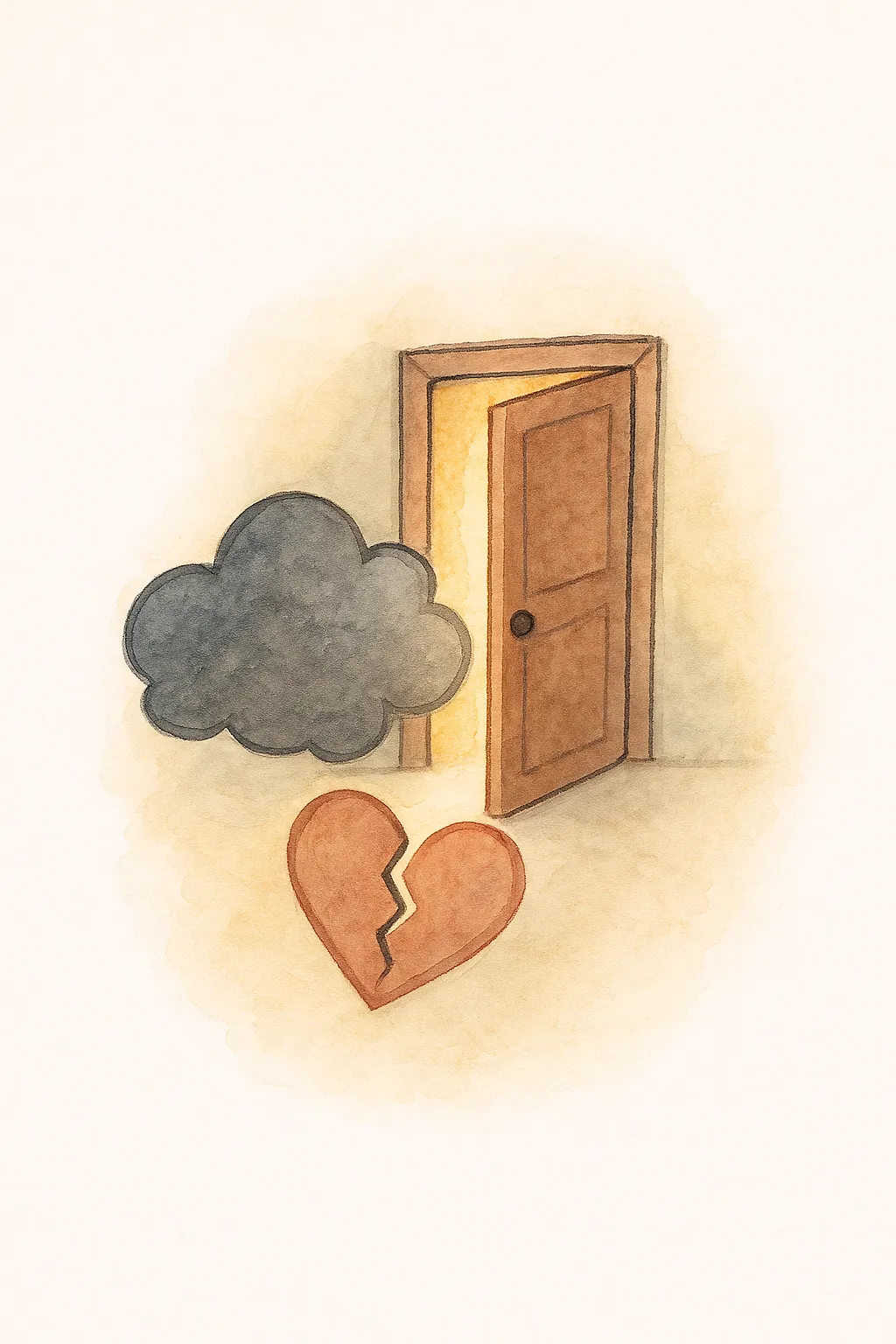
You spot them across the room. Your brain registers: interesting person, good moment, go. And then — nothing. Your feet stay planted. Your chest tightens. Three seconds pass, then ten, then the moment closes like a door swinging shut, and you're standing there replaying the non-event on loop for the next hour.
The frustrating part isn't the anxiety itself. It's that you know nothing bad was going to happen. The rational part of your brain had already done the math — worst case, an awkward five seconds. But knowing that didn't move your feet. That gap between knowing and doing is what makes approach anxiety so maddening for so many people.
So what's actually going on, and more importantly, how do you close that gap? The answer isn't a confidence mindset or a motivational script. It's physiology — and physiology is trainable. This article gives you a graduated exposure map, not a pep talk.
Before we get into the mechanics, here's a framework worth keeping in your back pocket: The Approach Window. The moment someone catches your attention, a window opens — and your nervous system will slam it shut in about three seconds if you don't move. This isn't a metaphor. It's a measurable feature of how your threat-response system works. The exercise at the end of this article asks you to identify one upcoming window and commit to entering it. Not nailing it — just entering it.
Why Does Approach Anxiety Feel So Physically Overwhelming Even When You Know the Situation Is Safe?
Approach anxiety feels so physical because it is physical. Your body is running a threat-detection program that evolved long before coffee shops existed, and it cannot easily distinguish between social risk and physical danger. The result is a genuine stress response — racing heart, shallow breath, muscle tension — triggered by a situation your prefrontal cortex has already classified as harmless.
This is the core mismatch. Your thinking brain and your threat-response system are not on the same network. The amygdala — the part of your brain that fires the alarm — doesn't wait for a logical review. It pattern-matches fast and acts faster. When approaching someone feels high-stakes (because rejection is a form of social exclusion, and social exclusion once meant real danger for our ancestors), the alarm goes off regardless of what you consciously know.
A lot of people interpret this physical response as evidence that something is wrong with them. It isn't. It's evidence that their nervous system is working exactly as designed — just in a context where the design is outdated. The problem isn't a character flaw. It's a calibration issue. And calibration is fixable.
Nobody teaches this stuff explicitly. You don't get a class in high school on building confidence in dating situations the same way you get taught to drive. So most people arrive at adulthood with a fully intact threat response and zero graduated exposure to the situations that trigger it. That's not weakness — that's just a gap in training.
What Is Actually Happening in Your Brain During the Seconds Before You Approach?
In the two to three seconds after you notice someone and before you act, your brain is running a rapid cost-benefit calculation — except it's wildly biased toward inaction. The potential downside (rejection, embarrassment) gets neurologically amplified, while the potential upside (connection, a good conversation) barely registers. This is negativity bias in real time.
Your body is already flooded with a small cortisol spike before you've taken a single step. Your attention narrows. You start generating mental scripts — what will I say, what if they're with someone, what if I come across weird — and each new "what if" adds another layer of arousal to the system. By the time ten seconds have passed, the window has closed and your nervous system has declared the threat neutralized by avoidance.
Avoidance is the key word here. Every time you feel the anxiety and don't approach, your brain logs that as: "we were in danger, we didn't act, we survived." That's a reinforcement of the anxiety response, not a relief from it. The relief you feel after not approaching is real — and it's exactly what keeps the pattern locked in place.
This is why fear of rejection doesn't fade just from thinking about it differently. The nervous system learns through experience, not through reasoning. You can't think your way out of a conditioned physical response. You have to move through it, repeatedly, in small enough doses that the system recalibrates.
How Do You Build a Personal Exposure Ladder That Shrinks Approach Anxiety Over Time?
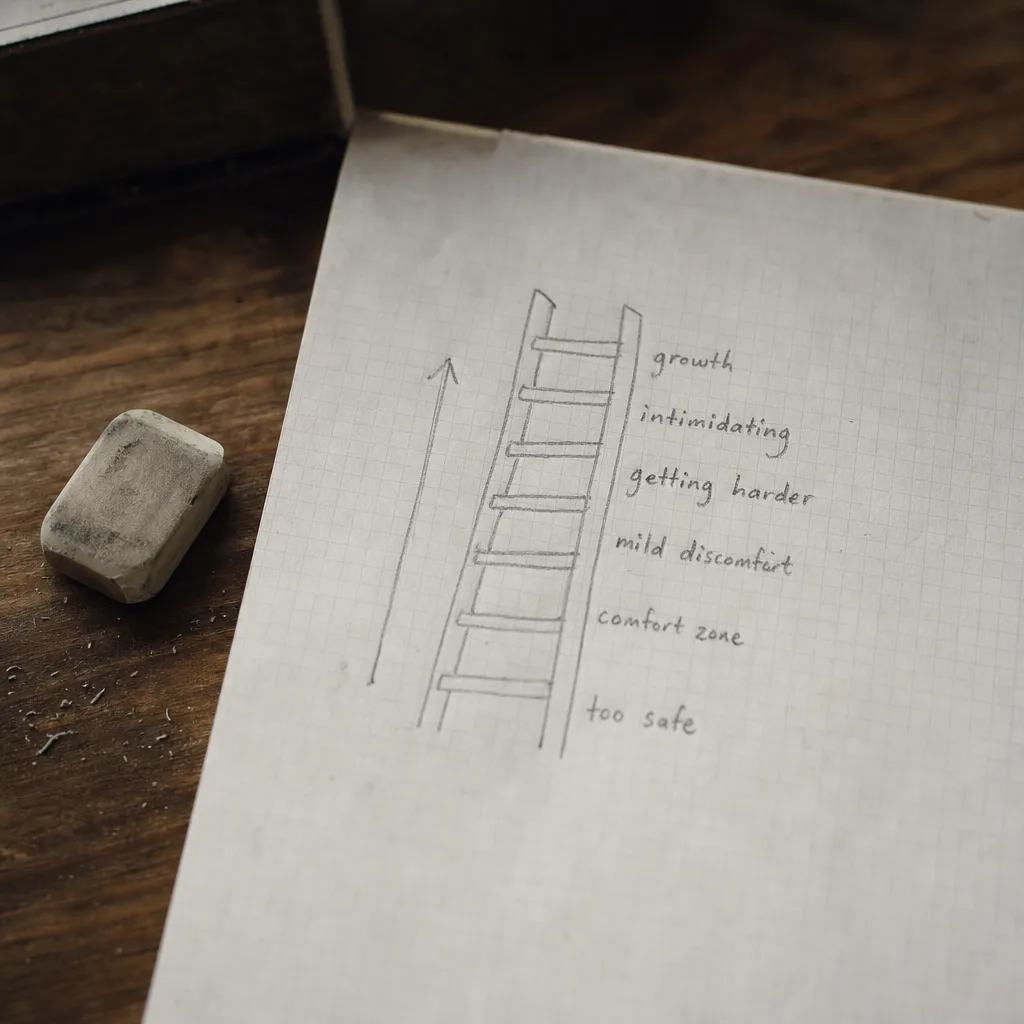
An exposure ladder is exactly what it sounds like: a sequence of increasingly challenging social interactions, ordered so each step feels slightly uncomfortable but not overwhelming. The goal is to give your nervous system new data — "we approached, nothing catastrophic happened, update the threat model." Over enough repetitions, the alarm gets quieter.
The bottom rungs are not "approach attractive strangers." That's the top of the ladder for most people starting out. The bottom rungs are things like: make eye contact and smile at a stranger while walking past. Say something brief to a cashier beyond the transaction. Ask someone nearby a low-stakes question — "do you know what time it," "is this seat taken." These aren't practice for being charming. They're practice for tolerating the moment of initiation. If you've ever wondered how to stop being shy in dating, this is where it actually starts — not with bold moves, but with these small, repeatable initiations that retrain the nervous system one rung at a time.
Once those feel genuinely easy — not just manageable, but actually boring — you move up. Extend a brief exchange by one more sentence. Comment on something in the environment to someone standing near you. Each step should produce a mild version of the anxiety signal, not a flood of it. If a rung feels paralyzing, you've skipped too far ahead. Go back one step. Knowing how to start talking to someone you like becomes much less daunting once the lower rungs feel genuinely routine.
Map your personal exposure ladder — five rungs, starting with something you could do today without much friction.
- Write down five social interactions ordered from "barely uncomfortable" to "genuinely scary." Be specific — not "talk to strangers" but "ask the person next to me in line if they've tried anything here before."
- Do rung one today. Not rung three. One.
- After you do it, write one sentence about what actually happened versus what you predicted would happen. That gap is your data.

Here's where the Approach Window becomes a practical tool rather than just a concept. As you work up the ladder, start using the three-second rule as a commitment device. When a window opens — someone looks up, there's a natural pause in the environment, you make eye contact — you have three seconds to move. Not to say something perfect. Just to move. The content matters less than the act of entering the window before it closes.
The skill of approaching someone you're interested in is genuinely learnable this way. Most people who seem naturally confident at this aren't born with a different nervous system — they've just accumulated more reps, often accidentally, through jobs or environments that forced low-stakes social initiation early in life.
Before you read on — think of one specific place you'll be in the next 48 hours where an Approach Window is likely to open. A coffee shop, a gym, a work event, a class. Name the place.
Hold that place in mind. The next section will tell you exactly what mistakes to avoid when you're there.
What Mistakes Keep People Stuck at the Bottom of the Ladder Despite Repeated Attempts?
The most common mistake is flooding. Someone decides they're going to "get over" their approach anxiety and immediately tries to approach the most intimidating person in the most high-pressure setting. The anxiety spikes hard, the interaction goes awkwardly because they're dysregulated, and their brain files it as: "confirmed dangerous, do not repeat." That's not exposure therapy — that's trauma reinforcement.
The second mistake is outcome-dependence. If the only version of "success" you're tracking is whether the person seemed interested, you're measuring the wrong thing. At the early stages of the ladder, success is defined as: did I enter the window? Full stop. Whether the conversation was great, whether they smiled back, whether anything came of it — that's noise. This is exactly the kind of scenario the practice mode in Dating Coach is built for: logging reps, not results.
A subtler mistake is mental rehearsal without physical action. A lot of people spend enormous energy imagining approaches, scripting openers, reading about what to say when asking someone out — and almost none of that translates to reduced anxiety in the moment. The nervous system doesn't update from imagination. It updates from doing. Reading this article is useful only if it leads to reps.
The fourth mistake is treating a bad interaction as evidence of permanent failure rather than as data. One awkward approach tells you almost nothing useful. Twenty approaches give you a pattern. Knowing how to handle rejection when it comes — logging it neutrally and moving to the next rep rather than analyzing it for hidden meaning about your worth as a person — is what separates people who improve from people who stay stuck.
How Do You Know When Your Approach Anxiety Has Shifted From a Block Into Background Noise?
The shift doesn't feel like the anxiety disappearing. It feels like the anxiety being present but smaller — a low hum instead of a siren. You notice it, you move anyway, and the gap between noticing and moving gets shorter. That's the signal. Not confidence as an absence of nerves, but confidence as a faster override. Learning how to be more confident in social situations is less about eliminating that hum and more about shortening the time between hearing it and acting anyway.
Practically, you'll notice a few things changing. The physical symptoms — tight chest, dry mouth, mental freeze — start arriving later in the process and leaving faster. You stop generating elaborate "what if" scripts before every potential interaction. You start noticing Approach Windows that you used to walk past without registering. And occasionally, you'll enter one without consciously deciding to, because the habit has started to run on its own.
Another marker: you start caring less about whether any individual interaction goes well, because you have enough volume that no single moment feels make-or-break. This is what asking someone on a date without it feeling awkward actually looks like in practice — not a perfect script, but a lower personal stakes per attempt because you've built a track record with yourself.
If you're unsure where you are in the process, here's a rough test: think about the last time a window opened and closed without you entering it. How long ago was that? How did it feel afterward — relief, or mild frustration? Relief means avoidance is still running the show. Mild frustration means you wanted to act and almost did — which means you're close. That frustration is useful. It's the signal that the gap between knowing and doing is narrowing.
You can also cross-check by noticing how you handle low-stakes social initiations — the cashier, the neighbor, the person in the elevator. If those feel genuinely easy now and they didn't six weeks ago, your nervous system has already started recalibrating. The same process, applied higher up the ladder, will do the same thing.
Approach anxiety isn't a personality type. It's a physiological response that got calibrated in one direction and can be recalibrated in another. The tool for doing that isn't a better mindset — it's graduated exposure, logged honestly, repeated consistently. Your nervous system is not your enemy here. It's just working with old data, and you're the one who gets to give it new data.
The Approach Window will keep opening, every day, in ordinary places. The question is just how many of them you enter this week versus last week. That number, tracked over months, is what overcoming fear of rejection actually looks like — not a breakthrough moment, but a slow, measurable shift in a trainable response. Start with one window. Then another. The nervous system will catch up.