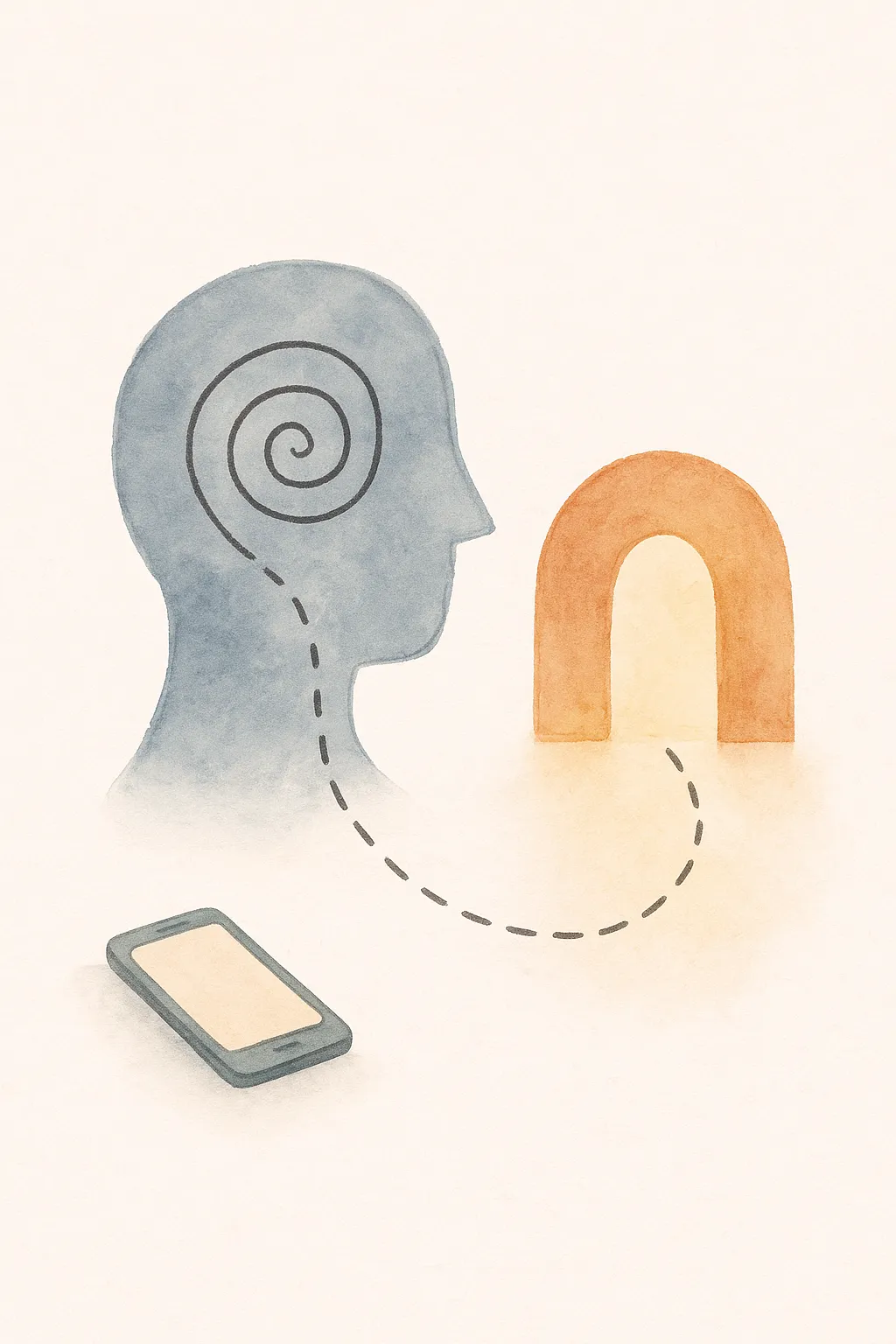
You refresh the app. Three new likes overnight. You open the first profile, feel a small spark of hope, then spend forty-five minutes drafting an opener you eventually delete. You close the app. This isn't a confidence problem in the way most people frame it — you're probably fine at parties, decent at small talk, maybe even charming when it counts. But something about dating apps specifically turns that version of you into someone who second-guesses every word and reads too much into response times.
That's because dating apps are their own environment with their own rules, their own feedback loops, and their own specific skills. Being good at in-person connection doesn't automatically transfer. The app is a different game — and nobody taught you how to play it.
So the question isn't "why am I not confident enough?" It's "what are the actual skills this platform requires, and how do I get better at them?" That's a much more answerable question. And this article answers it.
Why Does Swiping Feel So Demoralizing Even When You're Getting Matches?
Swiping feels demoralizing even with matches because the app's feedback system is designed around volume and speed, not quality. Every non-reply, every conversation that dies, every unmatched profile registers as a small rejection — even when it has nothing to do with you. The cumulative effect is a distorted signal that tells your brain you're failing, even when you're not.

The real problem is that you're evaluating yourself using metrics that aren't measuring what you think they're measuring. A match who doesn't reply might have opened the app once that week. A conversation that went flat might have died because they got busy, not because you said something wrong. The app collapses all of this complexity into a single number — your match rate, your reply rate — and your brain treats that number like a grade.
This is where the Confidence Loop becomes the most useful reframe available. Confidence isn't what you need going in — it's what you get coming out, after you've built a skill, practiced it, and seen it work. The loop runs like this: you identify a specific skill (writing openers, choosing photos, keeping a conversation moving), you practice it deliberately, you get a small win, and that win generates confidence. Then you bring more confidence to the next attempt. Confidence is the output of the loop, not the entry requirement.
Most people try to shortcut this by waiting until they feel confident before engaging seriously with apps. That's backwards. The demoralizing feeling comes precisely from skipping the skill-building phase and going straight to hoping the results feel good. When they don't, there's nothing to fall back on — no craft to refine, just a vague sense that you're not enough.
A concrete example: someone sends the same generic opener to fifty profiles, gets a 10% reply rate, and concludes they're unattractive. But the opener was the variable, not their face. A different opener — one that references something specific in the profile — can double that reply rate with no change to photos or bio. That's a skill gap, not a self-worth gap. If you've ever wondered why dating feels so hard even when you're putting in the effort, this is usually the reason: the feedback is misleading and the skills are invisible.
How Does App-Specific Confidence Actually Get Built (and Why It's Different From General Self-Esteem)?
General self-esteem is about how you feel about yourself across contexts. App-specific confidence is narrower and more useful: it's your belief that you know what to do on this platform. You can have low general confidence and high app confidence, or the reverse. They're separate competencies, and conflating them is what keeps a lot of people stuck.
Think about it like learning to drive. You might be a socially confident person who's terrible at parallel parking. The solution isn't to work on your self-esteem — it's to practice parallel parking. Dating apps work the same way. The skills are concrete: photo selection, bio writing, crafting openers that actually get replies, knowing how to transition a conversation toward a date. Each one is learnable.
The distinction matters because it changes where you put your energy. If you believe your low match rate is a self-worth problem, you'll try to fix it by working on your mindset. If you recognize it's a photo problem, you'll get better photos. One of those is actionable this week. Building real dating confidence almost always starts with a specific, fixable thing — not a vague internal shift.
Here's what that looks like in practice. Someone who struggles with starting conversations on Hinge might feel anxious every time they open a match. That anxiety isn't proof they're bad at dating — it's proof they haven't yet built the specific skill of writing a good first message. Once they have a few go-to approaches that have worked before, the anxiety drops. Not because they did inner work, but because they have evidence that they know what they're doing.
What Concrete Actions on the App Itself Reinforce the Confidence Loop?
The Confidence Loop needs inputs. You can't think your way into the wins — you have to generate them through deliberate action. Here's how that looks on an actual app, step by step.
Start with your profile, because it's the highest-leverage variable and the one you have full control over. Most profiles underperform not because the person isn't attractive, but because the photos are low-contrast, the bio is either empty or a list of adjectives, and there's nothing for someone to respond to. Fix one of those things this week. Just one. Notice whether your match rate changes. That's a data point, and data points build confidence faster than affirmations.
Next, work on your opener. This is the skill most people skip because it feels vulnerable, but it's also the one with the clearest feedback loop. Write five different openers for five different matches today — not the same one copy-pasted, but genuinely tailored to something in each profile. Track which ones get replies. You're not fishing for compliments; you're running an experiment. This is exactly the kind of scenario the Practice mode in Dating Coach is built for — low-stakes repetition with immediate feedback.
Pick the one skill in your Confidence Loop that's weakest right now — openers, photos, or keeping a conversation going — and run this drill.
- Write three different versions of that skill (three opener styles, three bio lines, three conversation pivots) without sending any of them yet.
- Read them back as if you received them. Which one would you actually respond to? That's your strongest version.
- Send it. Then note what happens — reply, no reply, or a conversation that goes somewhere. That's your data point for the week.

The conversation phase is where most confidence collapses. You get a reply, feel a rush of relief, and then freeze because you don't want to mess it up. The skill here is learning to keep a conversation going without over-investing in any single exchange. Treat each conversation as practice, not as a high-stakes audition. Some will go well. Some won't. The ones that don't are teaching you something.
Before you read on — what would YOU write here?
They've just replied to your opener with: "Ha, that's a good question. I don't know if I have a good answer." Take 10 seconds and draft your follow-up. Then compare with the example below.
How Can You Avoid the Metrics Trap That Quietly Destroys Dating App Confidence?
The metrics trap is treating your match rate, reply rate, or number of dates as a measure of your worth. It's an easy trap to fall into because the apps present these numbers constantly. But they're measuring the interaction between you and a specific algorithm on a specific platform on a specific day — not your value as a person or even your attractiveness in any real-world sense.
A low match rate on one app can become a high match rate on another, with zero changes to who you are. Different apps attract different user bases, use different ranking systems, and reward different profile styles. If you're struggling on one platform, that's information about the platform — not a verdict on you. Shyness in dating often gets reinforced by over-reading these numbers, when the actual issue is platform fit or profile execution.
The healthier metric to track is your own skill progression. Did your opener get a reply today that a previous version wouldn't have? Did you keep a conversation going past the third exchange, where you used to stall? Did you actually ask someone out instead of letting the conversation fade? Those are real wins, and they're the ones that feed the Confidence Loop properly.
One practical boundary that helps: set a session limit. Thirty minutes of intentional app use — sending thoughtful openers, responding to matches, maybe updating one profile element — is more valuable than two hours of passive scrolling and self-comparison. Overthinking every text exchange is a symptom of spending too long in the app without a clear goal. Go in with a task, complete it, leave. Part of what makes this hard is the pull toward seeking validation from every match and message — treating each reply as proof you're worth something, and each silence as proof you're not.
How Do You Know When Your App Confidence Is Ready to Transfer Into Real Conversations?
The signal isn't that you feel completely comfortable — it's that you stop treating every exchange as a test. When you notice you're curious about the person rather than anxious about your performance, that's the shift. You're no longer asking "am I doing this right?" You're asking "do I actually like talking to this person?"
That shift usually happens after you've accumulated enough small wins that the app stops feeling like a judgment machine. You've sent openers that worked. You've had conversations that flowed. You've asked someone out over text and survived the answer, whatever it was. The Confidence Loop has completed a few full rotations, and now you have evidence — actual evidence, not hope — that you know what you're doing on this platform.
The transfer to real conversation happens naturally from there. Once you're not white-knuckling every message, you start writing the way you'd actually talk. The gap between your app persona and your real self narrows. And when you eventually meet someone in person, you're not performing a version of yourself you built under pressure — you're just you, warmed up and genuinely interested. Becoming more charismatic in how you express yourself is a natural byproduct of this process — it emerges from comfort and practice, not from performing a character. That's when being more confident stops feeling like a project and starts feeling like a baseline.
If you're not sure whether you're there yet, ask yourself this: can you send an opener without editing it five times? Can you read a slow reply without your chest tightening? Can you end a conversation that isn't going anywhere without feeling like you failed? If yes to most of those, your app confidence is real. It's built. And it will hold up when the stakes get higher.
Dating apps are a skill environment with their own distinct rules — and the confidence you build inside them is a separate competency from how charming or attractive or interesting you are in the rest of your life. That's not a limitation; it's actually good news. It means the gap between where you are now and where you want to be is a skills gap, not a you gap. Skills close. You just have to start the loop.
When you treat the app as a practice environment rather than a verdict machine, everything changes. You stop waiting to feel ready and start getting good. And getting good — at openers, at conversation, at knowing when to move things offline — is exactly how the confidence that felt out of reach becomes the thing you just have.