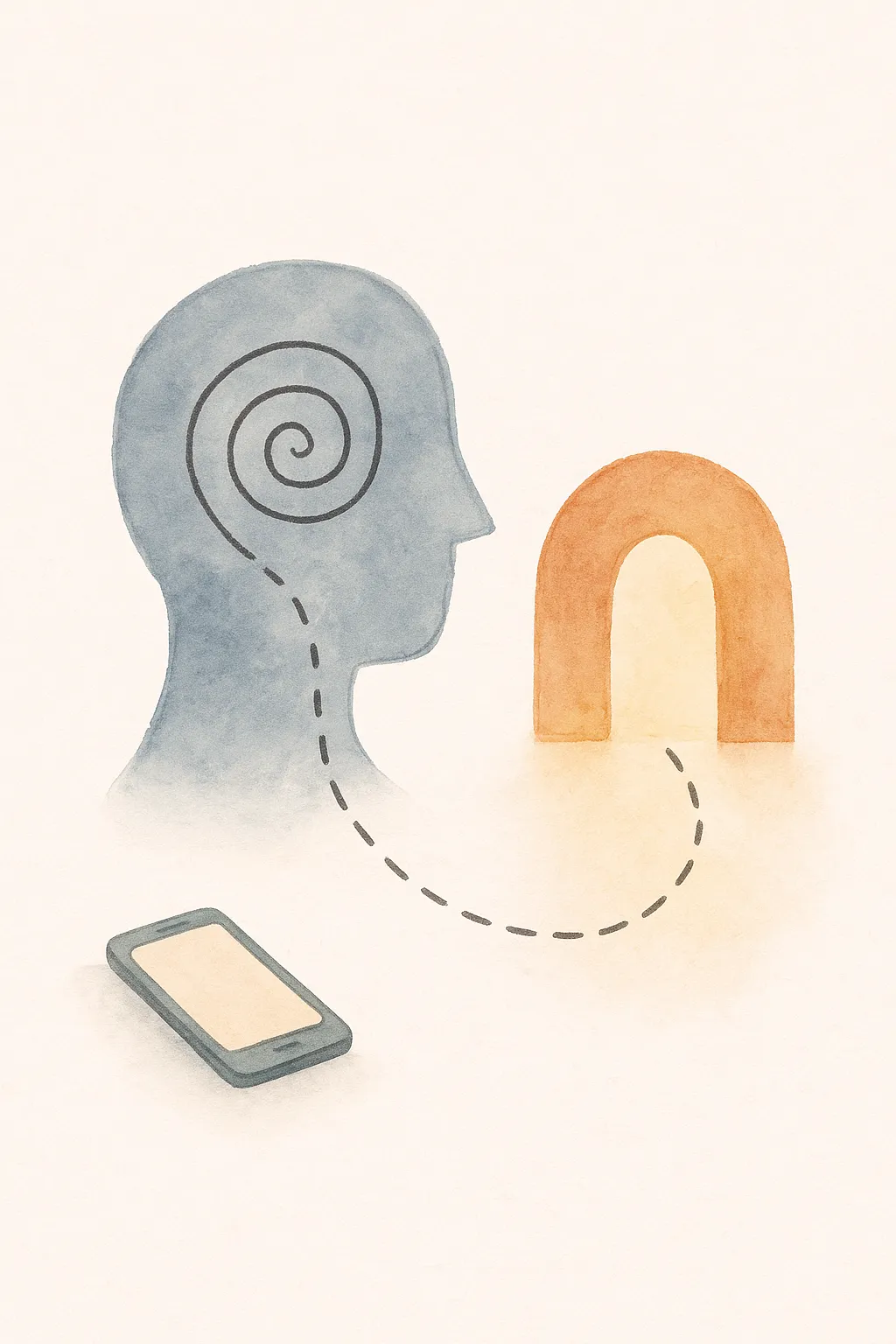
Your nervous system doesn't know the difference between a lion and a text that might get left on read. That's not a metaphor — it's literally how threat detection works. When you feel that cold dread before asking someone out, or that full-body freeze before sending a message, your brain has already run its calculation and decided: danger. Not embarrassment-level danger. Survival-level danger.
The complication is that nobody ever tells you this. So instead of recognizing a misfired alarm, you take the fear as evidence. Evidence that you're not ready, not good enough, not the kind of person who does things like this. The fear feels like a verdict. It isn't. It's just old code running on new hardware.
So the real question isn't "how do I stop being scared of rejection?" — it's "why is my brain treating a date as a threat to my life, and what do I actually do with that?" That's what this article is for. And the answer isn't to bulldoze the fear or pretend it doesn't exist. It's to understand what it's made of, so it stops making your decisions for you.
Before we get into the mechanics, here's a framework worth keeping: The Rejection Reset. Three moves — feel it, file it, forward. When rejection hits (or the fear of it does), you don't suppress it and you don't spiral into it. You feel it fully for a moment, then you categorize it — what actually happened, stripped of the story your brain added — and then you take one small forward action. We'll come back to this with a real exercise later. It's the difference between rejection being a wall and rejection being a data point.
Why does rejection feel like a threat to your survival, not just your dating life?
Rejection activates the same neural pathways as physical pain. Brain imaging studies show that social exclusion lights up the dorsal anterior cingulate cortex — the same region that fires when you stub your toe. Your brain genuinely cannot distinguish between "they said no" and "I've been cast out of the group and will not survive the winter."

This goes back further than you do. For most of human history, being rejected by your social group wasn't awkward — it was fatal. No tribe meant no food, no shelter, no protection. The people who survived were the ones whose brains treated social rejection as a serious threat. You inherited that wiring. It's not a flaw in your character; it's a feature that's wildly out of date for modern dating apps.
The problem is that your threat-detection system doesn't update automatically. It still runs the same code it ran 50,000 years ago, which means a "no thanks" from someone you matched with on an app can trigger the same cascade of cortisol and adrenaline as a genuine emergency. That's why rejection feels so disproportionate to the actual stakes. It's not weakness. It's evolutionary lag.
Take a concrete example: you've been talking to someone for two weeks, things feel good, and you finally ask if they want to grab coffee. They say they're busy and don't suggest another time. Logically, you know this is a minor social outcome. But your body goes into a low-grade panic — replaying the conversation, looking for what you did wrong, avoiding your phone. That's not you being dramatic. That's a threat-detection system doing exactly what it was built to do, just in completely the wrong context.
Understanding why rejection hurts so much at a biological level is the first step to not being controlled by it. Once you know the alarm is misfiring, you can start treating it like a misfiring alarm — something to acknowledge, not obey.
How does past experience wire your brain to expect rejection before it even happens?
Your brain is a prediction machine. It doesn't wait for evidence — it uses past patterns to generate expectations about the future, and then it filters incoming information through those expectations. If rejection has been a recurring experience, your brain doesn't just remember it. It builds a model: this is what happens when you try.
This is called predictive processing, and it's why anticipatory fear of rejection is often worse than the rejection itself. You haven't even asked yet, and your brain has already run the simulation a dozen times, each one ending badly. It's not pessimism. It's your nervous system being "efficient" — trying to protect you from a pain it has catalogued as significant.
Early experiences hit hardest. Being turned down in front of people in high school, a parent who was emotionally unpredictable, a relationship that ended with you being told you were "too much" — these don't just leave memories. They leave templates. Your brain uses them as reference points for what to expect from vulnerability. If the template says vulnerability equals pain, your system will try to prevent vulnerability before it can happen.
If you've ever found yourself overthinking texts for twenty minutes before sending something simple, this is the mechanism behind it. The overthinking isn't random anxiety. It's your brain trying to pre-empt the rejection it's already predicted. And the longer you let it run that loop, the more it reinforces the model.
Here's the thing about those past experiences: they were real, and they were hard. But they were data from a specific context, involving specific people, at a specific point in your life. Your brain filed them as universal rules. They aren't. Recognizing that distinction — between "this happened" and "this always happens" — is where the rewiring actually starts. If you want a practical roadmap for that rewiring process, the strategies for how to overcome fear of rejection go deeper into exactly how to update those templates.
What is your fear of rejection actually made of — and can you name it precisely?
"Fear of rejection" is a category, not a thing. When you zoom in, it almost always breaks down into something more specific — and more workable. Most people find their fear is actually one of a few distinct things: fear of embarrassment (someone will see them try and fail), fear of confirmation (the rejection will prove something they already believe about themselves), or fear of loss (they'll lose the possibility of something they haven't even started yet).
These are meaningfully different. Embarrassment fear is about audience — it spikes when other people might witness the attempt. Confirmation fear is the deepest one; it's the reason some people would rather never try than risk getting evidence that their worst self-assessment is accurate. Loss-of-possibility fear is almost paradoxical — you avoid asking because you don't want to lose the fantasy of what could happen, even though not asking guarantees you lose the reality.
Before you read on — which of those three feels most like yours?
Take 10 seconds. Name it. Then keep reading.
Naming the specific fear matters because it changes what you do about it. If it's embarrassment fear, the skill to build is approach anxiety management — learning to decouple your self-worth from the witness count. If it's confirmation fear, the work is in noticing the belief underneath and testing it against actual evidence instead of simulated outcomes. If it's loss-of-possibility fear, the reframe is that possibility without action is just a comfortable fiction.
Some people also discover their fear isn't really about the other person at all. It's about what they'll do with themselves after. If they get rejected, how will they handle it? They don't trust their own recovery. That's actually useful information — it means the skill gap isn't in asking, it's in bouncing back from rejection. And that's absolutely learnable.
Sometimes the fear of rejection shows up in your sleep — if you've ever dreamed about being rejected, that's your brain processing the same anticipatory anxiety while your defenses are down. It doesn't mean anything prophetic. It means the fear is getting enough airtime in your waking life that your sleeping brain is running the simulation too.
Run the Rejection Reset on the last time rejection (or fear of it) stopped you from doing something.
- Feel it: Write one sentence about what you felt in your body at that moment — not the story, just the physical sensation. Tight chest? Blank mind? Restless legs?
- File it: Write what actually happened, stripped of interpretation. Not "they rejected me because I'm boring" — just "I asked, they said no / I didn't ask because I assumed no." That's the file. Nothing added.
- Forward: Name one small action you could take in the next 48 hours that the fear was blocking. Not a grand gesture — just one step. Send the message. Make the plan. Ask the question.

How do you stop rejection fear from making decisions on your behalf?
Fear of rejection is sneaky because it rarely announces itself. It doesn't say "I'm afraid." It says "now isn't the right time," "I don't know them well enough yet," "the message isn't quite right," "I'll wait until I feel more confident." These are rationalizations, and they're convincing because they sound reasonable. But underneath each one is the same calculation: don't try, can't fail.
The way to catch this is to notice the pattern, not the excuse. If you consistently find reasons not to take the next step — not to ask someone out without fear, not to send the first message, not to suggest the second date — that consistency is the signal. Any individual reason might be legitimate. The pattern isn't.
One practical move: separate the decision from the feeling. The fear will almost always be present before you do the thing. That's just how it works — the alarm goes off whether or not there's a fire. The question isn't "do I feel ready?" (you probably won't). The question is "is there an actual reason not to do this, or is it just the alarm?" If it's just the alarm, you can acknowledge it and act anyway. That's not bravery as a personality trait. That's a skill.
Another move: shrink the ask. A lot of rejection fear is attached to the scale of what's being risked. If asking someone out feels enormous, it's partly because you've loaded it with meaning — this is a test of my worth, my attractiveness, my whole romantic future. Strip it back. It's an invitation. They can say yes or no. You'll be fine either way. Asking someone on a date without it being awkward is a learnable skill, and part of that skill is keeping the stakes in proportion.
When does working through rejection fear mean you're ready to date differently?
There's a version of "working on yourself" that's actually just a more sophisticated form of avoidance. You read the articles, you understand the neuroscience, you can explain your attachment style at dinner parties — and you still don't ask anyone out. Understanding the fear is necessary but not sufficient. At some point, the work has to show up in behavior.
You know you're making real progress when the fear is still there but it's no longer in charge. You feel the alarm, you recognize it for what it is — misfired threat detection, not a verdict — and you take the action anyway. The fear doesn't disappear. It just loses its veto power. That's the shift. It's subtle and it's significant.
The Rejection Reset is worth revisiting here, because this is where the "forward" step becomes habitual rather than effortful. Early on, taking forward action after rejection feels like pushing through something. Eventually it becomes the default — not because you've become fearless, but because you've built enough evidence that rejection doesn't actually end you. The file of "times I tried and survived" gets thicker, and the brain's prediction model starts to update.
You're also ready to date differently when you can build genuine confidence in dating from experience rather than waiting for confidence to arrive before you act. Confidence is the output of doing hard things, not the input. If you're waiting to feel confident before you try, you've got the sequence backwards. The reps create the confidence. The confidence doesn't create the reps.
Watch for the moment when a rejection happens and your first thought isn't "I knew it" but "okay, what's next?" That's not indifference. That's calibration. It means you've stopped treating every outcome as a referendum on your worth and started treating it as information about fit, timing, and circumstance — most of which had nothing to do with you.
If someone goes quiet after a promising start, knowing what to do when someone stops texting you without spiraling is a sign that the fear is no longer running the show. So is being able to handle rejection from someone you know without it wrecking the friendship or your self-image for a month.
Your nervous system was built for a world that no longer exists. It's running threat-detection code that served your ancestors well and serves you poorly in a dating app era. That's not a character flaw — it's a calibration problem. And calibration problems are fixable. Not by suppressing the alarm, but by updating the model it's running on, one rep at a time.
What changes when you practice this: you stop organizing your life around avoiding the feeling of rejection, and you start organizing it around what you actually want. That's a different way to live. And it turns out it's also a much more effective way to date.