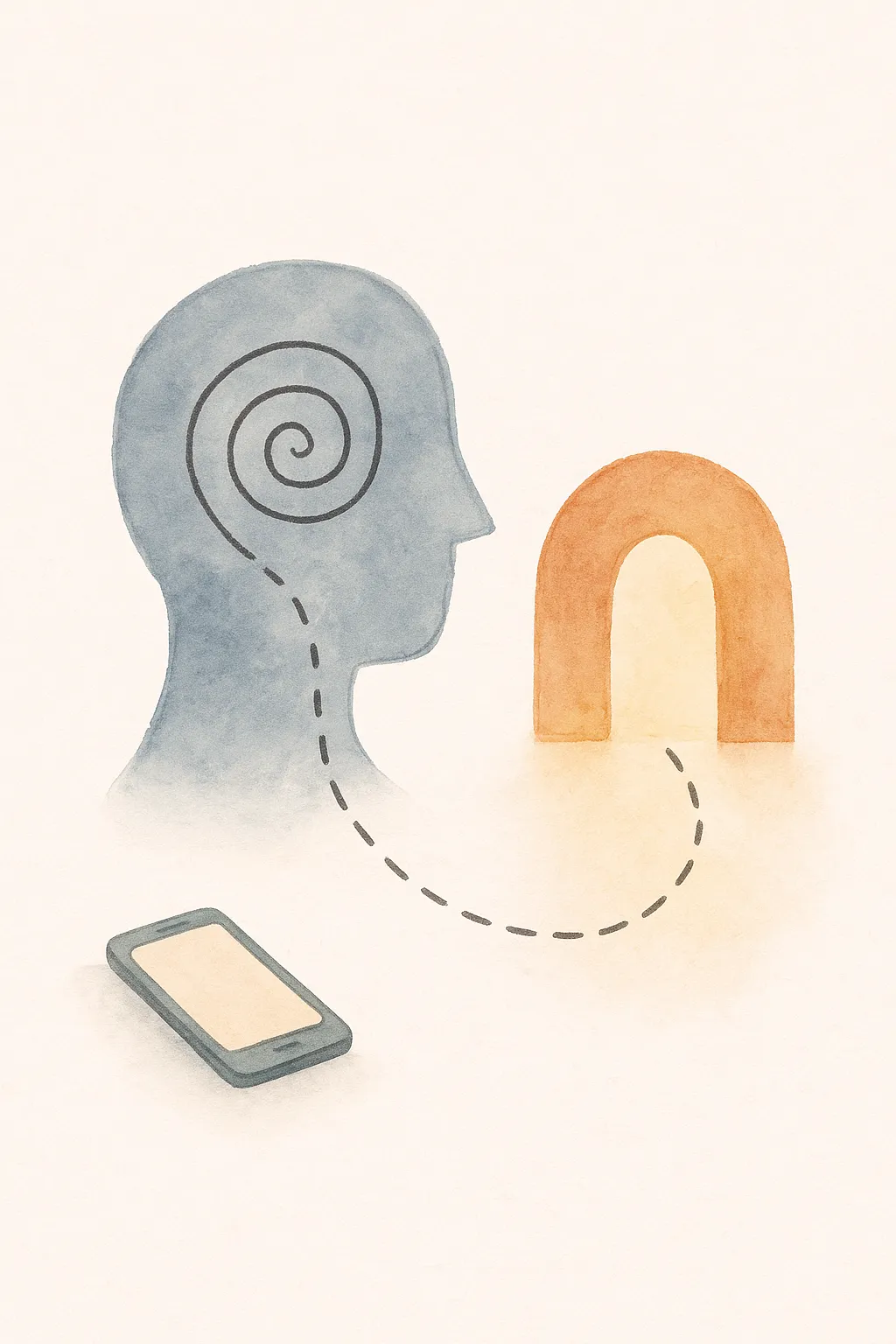
You sent the text. Or you asked them out. Or you leaned in at the end of the date. And they said no — or worse, they said nothing at all. In the seconds after, something strange happens: your brain doesn't file it under "useful information." It files it under "evidence." Evidence that you're too much, not enough, or fundamentally off in some way you can't quite name. That's the real problem with rejection. Not the moment itself, but the story your nervous system immediately starts building around it.
Here's what nobody tells you: rejection is data. It's a single data point from a single person at a single moment in time. But your brain — wired by evolution to treat social exclusion as a survival threat — doesn't process it that way. It processes it like a verdict. And once you're in verdict mode, you stop learning from the experience and start defending against it, which is where confidence quietly starts to erode.
So the real question isn't "how do I get tougher?" Toughening up just means feeling less, which means learning less. The question is: how do you extract the actual signal from a moment your nervous system coded as danger? That's the skill. And like any skill, it has steps you can practice. This article walks you through them.
Why Does Rejection Feel Like a Threat Instead of Just Information?
Because for most of human history, it was one. Social exclusion had real survival consequences, so your brain still runs that code. When someone turns you down, the social-pain circuits activate in patterns that overlap with physical pain — rejection literally hurts, neurologically. That's not weakness. That's ancient hardware meeting a modern situation it was never designed for.

That's the starting point for understanding why rejection hurts so much — it's not oversensitivity. It's a mismatch between ancient wiring and modern dating. The mechanism that kept your ancestors bonded to their tribe is now misfiring every time someone swipes left or doesn't text back. The system was never designed for this volume of low-stakes social feedback.
What makes this especially tricky is that the threat response doesn't distinguish between types of rejection. A stranger on an app saying "I don't think we're compatible" hits some of the same circuitry as being cast out of a community. Your brain doesn't automatically scale the response to the actual stakes. That's not a character flaw — it's just how the hardware works. The skill is learning to override the interpretation, not suppress the feeling.
This is also why fear of rejection can feel so disproportionate before anything even happens. You're not scared of the words "no thanks." You're scared of the threat signal your brain has pre-tagged that moment with. Once you understand that, you stop trying to eliminate the fear and start working with the system instead of against it.
What Actually Happens in Your Brain and Body the Moment You Get Rejected?
The sequence is fast. First, there's a spike in cortisol and adrenaline — the same stress hormones that fire when you sense physical danger. Your heart rate goes up. Your thinking narrows. This is the threat response kicking in, and it happens before your conscious mind has even finished processing what was said to you.
Then comes the narrative layer. Within seconds, your brain starts pattern-matching: "This has happened before. What does it mean?" If you've been rejected in similar circumstances, those memories get pulled up. If you already have a story about yourself — that you're "bad at dating" or "not attractive enough" — the rejection gets slotted in as confirmation. This is the part that does the real damage, because you're not just experiencing a rejection anymore. You're building a case.
Consider what this looks like in practice. Someone you've been texting for two weeks goes quiet after you suggest meeting up. Your nervous system reads it as rejection. The cortisol hits. Then the narrative starts: "They lost interest. I probably said something wrong. This always happens." By the time you're lying in bed that night, a single unanswered text has become a referendum on your desirability. That's not analysis — that's your threat system running unchecked. (If this specific scenario sounds familiar, what to do when someone stops texting you breaks down how to handle it without the spiral.)
The good news is that the narrative layer is where you have leverage. You can't stop the cortisol spike. But you can interrupt the meaning-making that follows it. That's exactly what the three-step process below is designed to do.
How Do You Process a Rejection Without Letting It Rewire Your Confidence?
This is where The Rejection Reset comes in. Three steps: Feel it, File it, Forward. Not as a way to rush past pain, but as a structured way to keep a single data point from becoming a belief system.
Feel it means giving the discomfort actual space — not performing toughness, not immediately distracting yourself with your phone. Sit with the sting for a defined window. Ten minutes, twenty minutes, whatever it takes to let the cortisol settle. Research on emotional processing consistently shows that suppressed emotions don't disappear; they just resurface later with more force. You're not wallowing — you're clearing the buffer.
File it is where the real skill lives. This step asks: what is this rejection actually telling you, and what is it not telling you? A useful filing question is: "What do I know for certain from this?" Not what you fear, not what it might mean — what you actually know. Maybe you know they weren't ready to date seriously. Maybe you know the timing was off. Maybe you genuinely don't know anything beyond "this one didn't work out," and that's the only honest file. If you've ever woken up still turning a rejection over in your mind, it's worth knowing that what rejection dreams are really processing often mirrors this exact filing stage — your sleeping brain trying to close a loop your waking mind hasn't finished yet.
Think of your most recent rejection — even a small one. Walk it through all three steps of The Rejection Reset.
- Feel it: Write one sentence describing exactly how it felt in your body in the moment — not what you thought, what you physically felt.
- File it: Write what you know for certain from this rejection (facts only, no interpretations). Then write what you were tempted to conclude that isn't actually supported by the facts.
- Forward: Write one specific, small action you could take in the next 48 hours that moves toward what you want — a new conversation, a message to someone you've been hesitating on, or even just re-reading how to overcome fear of rejection to reinforce the skill.

Forward doesn't mean immediately putting yourself back out there to prove something. It means taking one small, chosen action that reinforces your agency. The goal is to interrupt the pattern where rejection leads to withdrawal, which leads to less practice, which leads to more fear. One action — even a low-stakes one — keeps the skill loop open.
Here's what this looks like in a real conversation context. Say you asked someone out and they said they weren't interested. You feel the sting (Feel it). You note that they were warm but clearly not available romantically — maybe they mentioned being focused on work (File it). Then you reply with something clean and graceful:
What Are the Most Common Ways People Handle Rejection That Make It Worse?
The most common one is immediate over-analysis. You replay every message, every moment on the date, every word choice, looking for the exact thing you did wrong. This feels productive because it's active. It isn't. What you're actually doing is training your brain to treat rejection as a puzzle you failed to solve, which makes the next attempt feel even more high-stakes.
A close second is the overcorrection: deciding that the reason you got rejected is a fundamental trait you need to change. Someone didn't text back, so now you're convinced you need to be funnier, or less intense, or more mysterious. One data point cannot tell you that. If you find yourself restructuring your personality after a single rejection, that's your threat system talking, not useful signal. Building confidence in dating actually works in the opposite direction — it comes from accumulating reps, not from retrofitting your identity after each setback.
Before you read on — think about the last time you got rejected. What did you do in the hour after?
Take 10 seconds. Notice whether your response moved you toward or away from the next attempt.
Another pattern that quietly does damage: ghosting yourself. Someone ghosts you, and instead of processing it cleanly, you spend days checking their profile, re-reading old messages, and constructing theories. Why people ghost is rarely about you specifically — but the uncertainty makes the threat response worse, because your brain can't file an incomplete story. The fix is to file it anyway, with the honest label: "I don't have enough information to know what this means, and that's the actual data." For people who tend to go quiet and pull back after a rejection, learning how to stop being shy in dating can be the missing piece — shyness and rejection sensitivity often reinforce each other in a loop that's worth breaking deliberately. Learning how to be more confident in these ambiguous situations means getting comfortable closing the loop yourself, rather than waiting for an explanation that may never come.
How Do You Know When You've Genuinely Reset — and Are Ready to Try Again?
The clearest signal is that you can tell the story of the rejection without it pulling you into the verdict. You can say "they weren't interested" without it immediately connecting to "because I'm not enough." When the data point stays a data point — when it doesn't automatically recruit a supporting cast of old rejections and self-doubts — that's the reset working.
A practical test: think about the person who rejected you and notice what you feel. If it's mild disappointment or simple neutrality, you've processed it. If it's still a hot charge of shame or a compulsive need to understand what went wrong, there's more to file. That's not failure — it just means you haven't finished the Feel it step yet, and rushing to Forward before that's done tends to produce the avoidance patterns discussed above.
Readiness to try again doesn't mean the fear is gone. Approach anxiety often sticks around even after you've processed a rejection cleanly. That's normal — it's the anticipatory version of the same threat signal. What changes after a genuine reset is that the fear is no longer running on the fuel of the last rejection. It's just the standard pre-attempt nerves, which is workable. When you're ready to act on that, knowing how to approach someone you like with a clear, low-pressure strategy makes it easier to take the first step without overthinking. If you're wondering whether a specific situation is worth attempting again, how to ask someone on a date without it being awkward can help you think through the setup.
One edge case worth naming: if you find that no amount of processing seems to clear the charge — if rejections keep compounding and the fear keeps growing despite genuine effort — that's a signal that the pattern runs deeper than any single technique can address. That's not a dating problem at that point; it's worth exploring with a professional. Most people aren't in this category, but if it resonates, it's worth naming honestly.
The other thing that signals genuine readiness is curiosity. When you can approach a new person and feel genuinely interested in what they're like — rather than primarily focused on whether they'll accept or reject you — the reset has done its job. Curiosity and threat don't coexist easily. If curiosity is back, the threat signal has quieted enough to work with.
Rejection was never a verdict. It was always a data point — one you now have the tools to read clearly instead of flinching away from. The nervous system will still do its thing. The cortisol will still spike. But between the spike and the story, there's a gap. That gap is where the skill lives. Every time you run Feel it, File it, Forward, that gap gets a little wider, and the verdict a little quieter. What changes with practice isn't that rejection stops mattering — it's that it stops deciding anything about you.