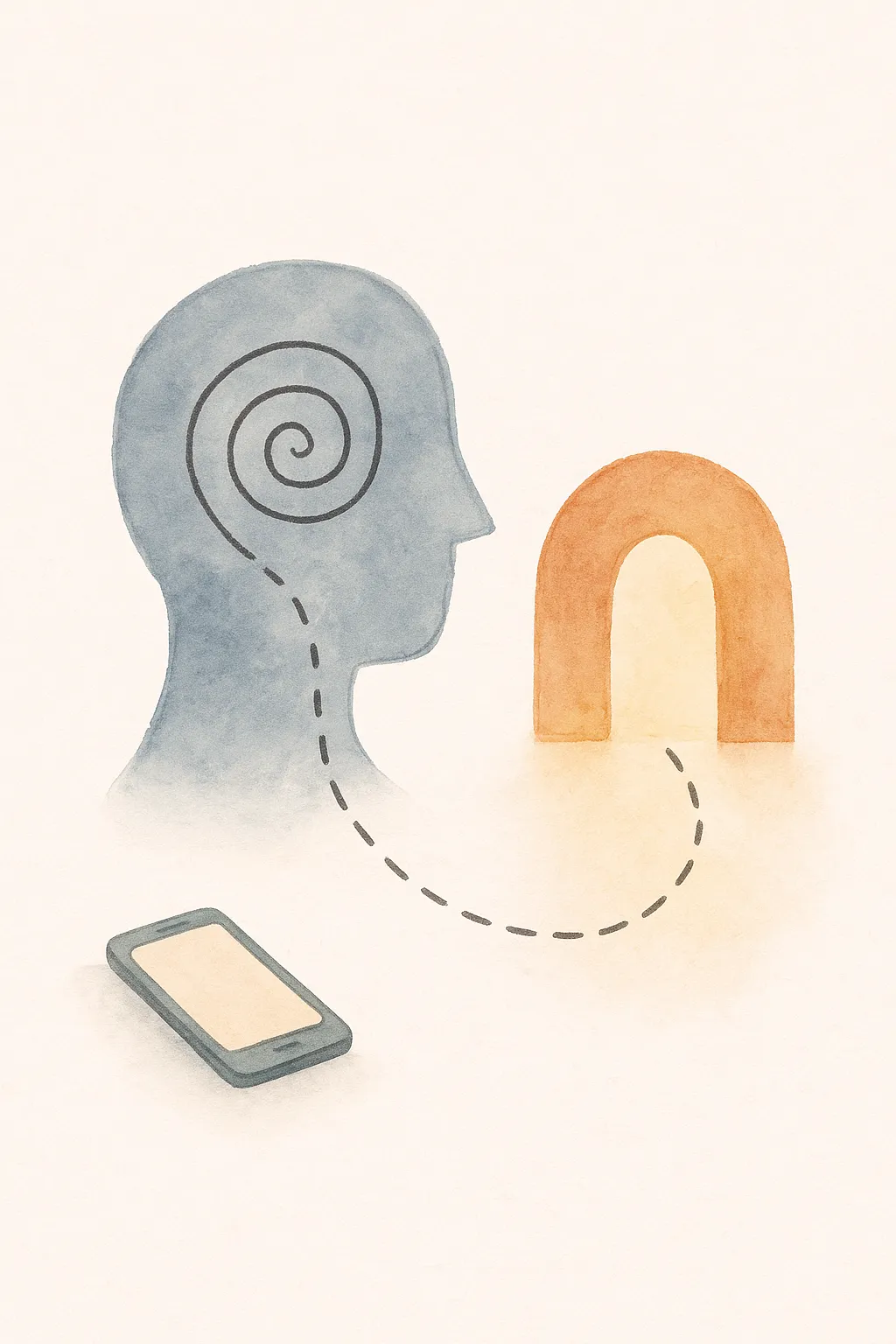
You're mid-sentence with someone you actually like, and your brain decides to stop working. You know how to talk to people — you do it constantly — but something about this person triggers a kind of cognitive static that turns a normal conversation into a performance review you didn't study for.
That's not a personality flaw. It's a signal. Specifically, it's your nervous system treating a social situation like a high-stakes test because nobody ever taught you that talking to people you're attracted to is a trainable skill — the same way a tennis serve is trainable. You weren't born able to serve an ace, and you weren't born knowing how to stay relaxed and interesting when attraction is in the room. Both take reps.
The question isn't "why am I like this?" The question is: what does the practice ladder actually look like? That's what this article is here to answer.
Why Does Talking to Someone You Like Feel Harder Than Talking to Anyone Else?
Talking to someone you're attracted to feels harder because your brain assigns higher stakes to the outcome. The same neural circuits that handle threat detection activate when rejection becomes possible — flooding your working memory with self-monitoring, which crowds out the relaxed, spontaneous thinking that makes conversation good.

This isn't abstract. When you're chatting with a coworker you have zero interest in, your prefrontal cortex is running normally. The moment attraction enters the equation, a part of your brain starts running a parallel process: "How am I coming across? Is this landing? Do they like me?" That split attention is why you suddenly can't think of anything to say to someone you'd have no problem talking to in any other context.
The mechanism also explains something called the The Approach Window — the brief moment, usually around three seconds, where your instinct tells you to say something. If you don't act within that window, your brain closes it. It reclassifies the situation as "too risky" and manufactures reasons not to engage: they look busy, it's bad timing, you'll catch them later. You won't. The window doesn't reopen on better terms. This is why overcoming approach anxiety isn't about finding the perfect moment — it's about learning to move before your brain talks you out of it.
Here's what makes this solvable: the difficulty isn't caused by who you are, it's caused by insufficient exposure to the specific stimulus. Most people have talked to thousands of strangers but have very few deliberate reps talking to people they're attracted to while staying calm and present. That gap is just a training gap. It closes with practice, not with a better attitude.
How Does Deliberate Practice Actually Build Conversational Skill With People You're Attracted To?
The key word is "deliberate." Waiting around hoping the next conversation goes better isn't practice — it's just more of the same experience. Deliberate practice means designing progressively harder reps, tracking what happens, and adjusting. Building confidence in dating works exactly the same way as building confidence in public speaking: exposure, feedback, iteration.
The ladder has to start below the level that triggers full anxiety. If talking to someone you find extremely attractive currently shuts you down, starting there is like trying to bench press your max on day one. You'll fail, feel bad, and avoid the gym. Instead, you start with conversations that have some social pressure but not maximum stakes — a friendly cashier you see every week, a classmate you find mildly interesting, anyone where there's a small but real social cost to the interaction going awkwardly.
Each rung on the ladder increases the stakes slightly. The goal isn't to feel zero nervousness — nervousness is information that you care about the outcome, which is actually useful. The goal is to shrink the gap between "nervous" and "functional." You want to be able to feel the flutter and still form a coherent sentence. That gap shrinks through volume, not through waiting until you feel ready. As your comfort grows, you can start adding more playful, charged exchanges — learning how to flirt in person becomes a natural next step once the basic conversational muscle is in place.
This is exactly the kind of scenario the Practice mode in Dating Coach is built for — short, realistic exchanges where you can try a line, see how it lands, and adjust before the real conversation happens.
What Specific Reps Can You Do This Week to Get Better at Talking to People You Like?
Start with volume at low stakes. Your goal this week isn't to approach your biggest crush — it's to have five brief, low-pressure conversations with strangers or acquaintances where you say one thing you wouldn't normally say. A genuine observation, a specific question, a small joke. This trains the muscle of speaking before the inner editor shuts you down.
Before you read on — think of one recurring situation this week where you'll see someone you're attracted to. A coffee shop, a class, a gym, a work meeting.
Hold that specific scenario in mind. The next section gives you a concrete rep to run in exactly that situation.
Once you have that scenario, here's the rep: identify The Approach Window in advance. You already know roughly when it will open — when they walk in, when the class ends, when you're both waiting for something. Commit now to entering the window when it appears. Not with a perfect line. With anything. "Hey" and a specific observation beats standing there composing a speech while the window closes.
Pick one upcoming situation this week where you'll be near someone you find attractive, and run this practice sequence:
- Before the situation: write down one specific, genuine observation you could make about the context you'll be in — not a compliment, just something real ("This place is always packed on Tuesdays" / "I never know what to order here")
- During the situation: when the window opens, say the observation out loud within three seconds. Don't revise it. Don't wait for a better one.
- After: note one thing that happened in the conversation — what they said, how it felt, what you'd change. One sentence. This is your feedback loop.

The feedback loop in step three is what separates practice from just "doing stuff." Starting a conversation with someone you like gets easier faster when you're actually tracking what happens, even informally. Your brain needs signal to calibrate — "that landed well" or "I went blank when they asked a follow-up" is genuinely useful data.
How Do You Avoid the Two Practice Traps That Keep Most People Stuck at the Same Level?
The first trap is practicing only in your head. A lot of people spend enormous energy mentally rehearsing conversations that never happen — running scenarios, scripting lines, imagining responses. This feels productive. It isn't. Mental rehearsal can reduce anxiety slightly, but it doesn't build the actual skill because the actual skill requires real-time response to unpredictable input. You can't rehearse spontaneity. You can only get reps of it.
The second trap is practicing only at maximum difficulty. Some people swing the other way — they decide the cure for approach anxiety is to force themselves into the hardest possible situations immediately. Cold-approaching the most attractive person in the room, asking someone out on the first exchange, going from zero to sixty. Sometimes this works. More often it just confirms the fear: "See, I panicked, it went badly, I'm not good at this." Approaching someone you like well is a skill that needs a ramp, not a cliff jump.
The way out of both traps is the same: structured reps at the right difficulty level. Hard enough that there's real social pressure, easy enough that you can stay functional. If you freeze completely, the rep was too hard — step down. If you feel nothing, step up. You're looking for the zone where you feel nervous but can still think. That's where growth happens.
There's also a subtler version of trap one worth naming: using texting as a substitute for in-person practice. Texting someone you like is useful — talking to your crush over text builds some conversational instincts — but the anxiety response that shuts you down in person doesn't activate over text. So text practice doesn't transfer as cleanly as you'd hope. It supplements real-world reps; it doesn't replace them. Learning how to approach someone without being awkward in person is ultimately what moves the needle, and that only comes from showing up and doing it. Social settings like bars are a particularly useful training ground — knowing how to approach someone at a bar gives you a high-volume environment where the reps come naturally and the stakes feel real but recoverable.
How Will You Know Your Conversations With People You Like Are Actually Improving?
Progress in this skill looks different from progress in most skills because the output isn't always obvious. You won't get a score. But there are real signals. The clearest one is recovery speed — how quickly you get back on track after a moment of awkwardness or a blank. Early on, one stumble can derail an entire conversation. As the skill develops, you recover in a sentence or two and keep going. That's a measurable shift.
Another signal is the quality of your follow-up questions. When you're anxious, questions tend to be generic ("what do you do?", "where are you from?") because your brain is running on autopilot to conserve bandwidth. When you're more comfortable, you start asking questions that are specific to this person, this moment — which is what makes conversation flow naturally instead of feeling like a job interview. If you notice yourself asking more specific questions over time, that's a real indicator.
You'll also notice the The Approach Window getting easier to enter. Not because the nervousness disappears — it probably won't, and that's fine — but because the gap between "I want to say something" and "I actually say it" gets shorter. That gap is the skill. Closing it is the whole game. When you can feel the window open and walk through it without a three-minute internal debate, you're improving.
One more indicator: you start caring less about how individual conversations go and more about what you learned from them. That's the mindset of someone who's actually practicing, not auditioning. Never running out of things to say isn't about having more material — it's about being curious enough that the conversation generates its own momentum. When you start feeling that, you'll know the reps are adding up.
Attraction-triggered awkwardness is a signal that you care — and caring is not the problem. The problem was never having a structured way to train through it. You have one now. The conversations that used to shut you down are just the next rung on the ladder, and ladders are meant to be climbed one step at a time. Every rep you take this week is data. Every window you enter — even if it goes sideways — is a rep that makes the next one easier.
What changes when you practice this consistently isn't that you become fearless. It's that the fear stops being the deciding factor. You'll still feel it. You'll just keep talking anyway.