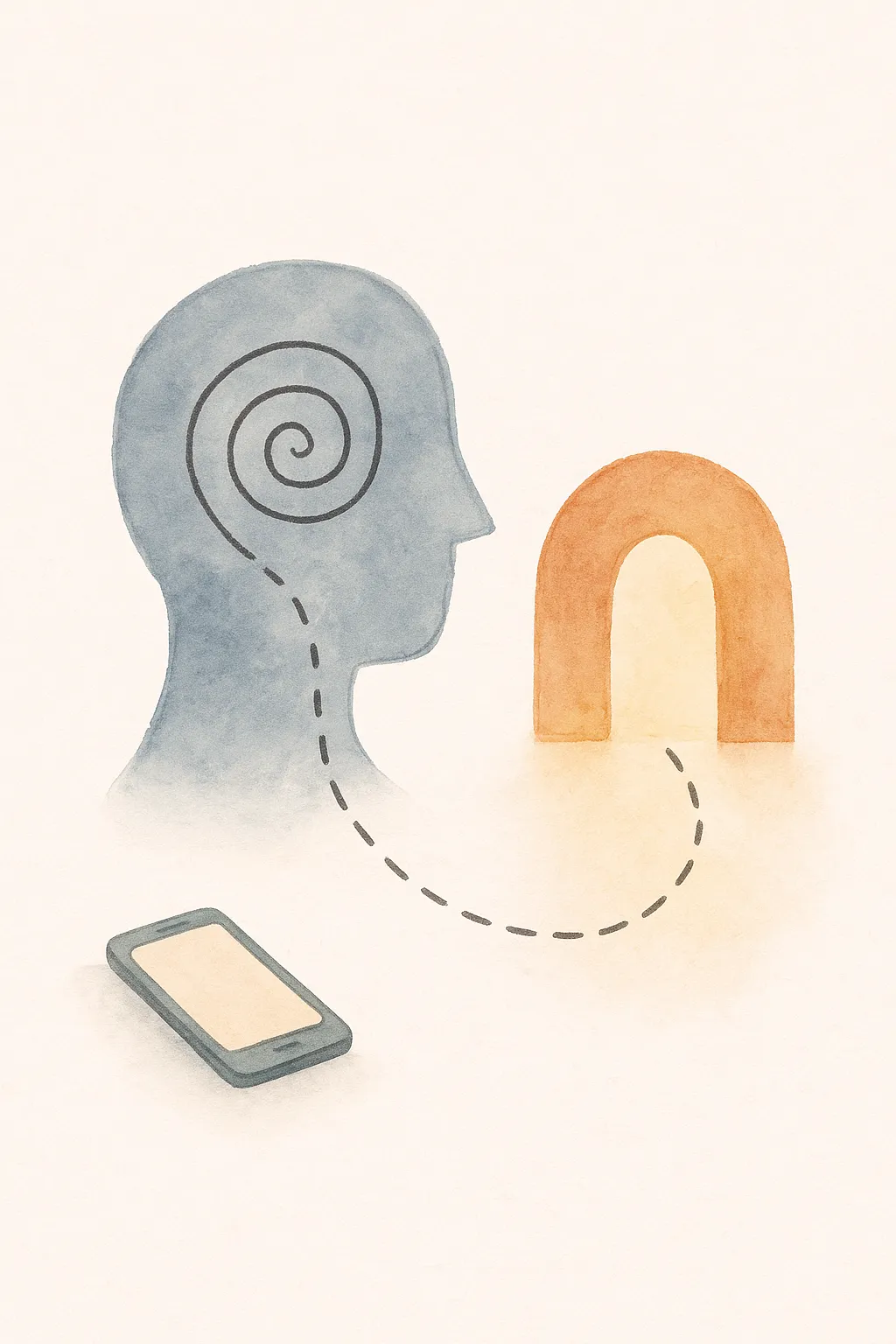
You see them across the room. There's a half-second where everything is clear — you want to walk over, say something, make something happen. Then your brain catches up and starts running calculations. What would I even say? Is this a weird moment to approach? Do I look like I was just standing here waiting? And then the moment is gone, and you're staring at your phone pretending to check something important.
That's the frustrating part. The problem usually isn't that you don't know how to talk to people — you do it all day. It's that this specific situation gets loaded with so much meaning before you even open your mouth that the approach itself becomes a performance you're trying not to mess up. That framing is what kills it.
The real skill isn't crafting the perfect opener. It's recognizing a window when it appears and stepping through it before your brain talks you out of it. That's what this article is about — not the script, but the timing and the mechanics of actually going.
Why does approaching someone you like feel so different from just talking to a stranger?
Approaching someone you like feels different because your brain has pre-assigned stakes to the outcome. With a stranger, there's no emotional investment. With someone you're attracted to, your mind has already run a simulation of what this could become — so rejection doesn't feel like a failed hello. It feels like a closed door.

This is why approach anxiety hits people who are otherwise confident and socially fluent. It's not a personality flaw or a sign that something is wrong with you. Nobody teaches this skill explicitly — most people just absorb whatever worked or didn't work in high school and carry that forward. The mechanics of approaching someone you're genuinely interested in are learnable, but you have to actually treat them as a skill rather than a personality trait you either have or don't.
The emotional weight also creates a cognitive bottleneck. Your working memory gets occupied with self-monitoring — how do I look, what do I say, are they interested — which leaves fewer mental resources for the actual conversation. The result is that you come across as stiffer and less natural than you would if you'd just walked up to ask a stranger for the time. The irony is that the more you care, the more you can undermine yourself in the moment.
Understanding this mechanism matters because it shifts where you focus your energy. The goal isn't to feel less nervous — nerves are fine, they mean you care. The goal is to act before the self-monitoring loop fully kicks in. That's where the timing piece becomes everything.
What actually happens in the moment before a good approach — and why timing matters more than your opener?
There's a specific window — call it The Approach Window — that opens briefly when the conditions are right: they're not mid-conversation, not clearly occupied, maybe they've glanced your way, maybe there's a natural pause in the environment. That window exists for roughly three seconds before your brain starts generating reasons not to use it. After about five seconds of hesitation, most people have fully talked themselves out of it, and the moment has passed in a way that's genuinely hard to recover.
This isn't a motivational metaphor — it's how the brain actually works. When you hesitate, your threat-detection system starts treating the approach as a risk that needs more analysis. The longer you wait, the more analysis gets added, the more the approach feels like a big deal, and the more your body language starts to telegraph that internal conflict. By the time you do walk over, you've already made it weird — not because of anything you said, but because you've been standing there visibly deciding for 30 seconds.
Good approaches look effortless because they're immediate. The person who walks over within a couple of seconds of noticing the window reads as confident and natural — not because they're performing confidence, but because they haven't given themselves time to perform anything. The action precedes the anxiety spiral rather than following it. This is exactly the kind of scenario the Practice mode in Dating Coach is built for: training yourself to act on the window rather than analyze it.
Timing also matters because context shifts fast. Someone standing alone waiting for a friend has a two-minute window before the friend arrives. Someone at the end of a coffee shop queue has about forty-five seconds before they reach the counter. Reading the window isn't just about their body language — it's about the situation's natural expiration date. A good approach works with the context, not against it.
How do you start a conversation with someone you like without it feeling forced or rehearsed?
The opener matters much less than people think, but it matters in one specific way: it should be low-effort enough that it doesn't feel like a performance. The goal of the first sentence is not to impress — it's to open a loop that invites a response. Anything that's genuinely observational, situationally relevant, or lightly curious does this better than any line you could memorize. Understanding how to start talking to someone you like comes down to this: specificity beats cleverness every time.
Before you read on — what would YOU say to open a conversation with someone you've just noticed at a bookstore, standing near the same section as you?
Take 10 seconds. Then compare with the example below.
Something like "Do you actually read these or are you just judging the covers like I am?" is better than "Come here often?" not because it's wittier, but because it's specific to the moment and low-stakes — it's easy to respond to, and it signals that you're a person with a perspective, not someone reciting a script. The specificity is what makes it feel natural.
If you're drawing a blank on what to say, the easiest framework is: make an observation about something both of you can see, add a light opinion or question, and let them respond. That's it. You're not trying to be memorable in the first thirty seconds — you're trying to make it easy for them to talk back. Keeping the conversation going after that is a separate skill you can build, but it starts with giving them something to respond to rather than something to evaluate.
Pick one real upcoming situation where you're likely to be around someone you find attractive — a class, a gym, a social event, a coffee shop you frequent.
- Name one specific, situationally relevant observation you could open with in that context (not a compliment — something about the environment or shared experience)
- Commit to a window: decide in advance that if the conditions are right — they're alone, not occupied, there's a natural pause — you'll enter the window within 3 seconds of noticing it
- After the situation, note what actually happened — not to grade yourself, but to start building a map of what windows look and feel like in real life

What are the most common mistakes that kill an approach before it even begins?
The biggest one is waiting until you feel ready. Readiness doesn't come before the approach — it comes from doing it. A lot of people treat the pre-approach phase as preparation, when it's actually just delay. If you've been standing somewhere for more than a few seconds running mental rehearsals, the window has probably already closed and you're now in a different problem entirely: managing fear of rejection rather than approaching.
The second mistake is over-engineering the opener. If you've written and discarded three possible opening lines in your head, that's a signal that you've shifted from "approaching someone" to "performing for someone." The performance framing is what makes approaches feel weird — both to you and to them. They can usually sense when someone has rehearsed what they're about to say, and it creates a subtle distance rather than connection. Learning how to be more confident in these moments is less about rehearsing lines and more about trusting that an imperfect approach beats no approach every time.
Third: telegraphing the stakes. Phrases like "I don't normally do this" or "this is probably weird" are attempts to pre-empt rejection by lowering expectations, but they actually raise the social pressure in the room. They signal that you've assigned this interaction a lot of weight, which makes the other person feel responsible for managing that weight. A simple, direct approach — even an imperfect one — lands better than an anxious, heavily prefaced one every time. If shyness is part of what's holding you back here, it's worth understanding how to stop being shy in dating as a broader pattern, not just a moment-to-moment fix.
Finally, there's the mistake of treating a neutral response as rejection. If they're polite but not immediately warm, that's not a no — that's a normal human being who just met a stranger. Most people need a sentence or two to calibrate. Reading interest accurately takes practice, and the early seconds of an approach are almost never the moment to make that call.
How do you know if the approach landed — and what's the right next move after you've walked up?
An approach that "lands" doesn't mean they're immediately flirting back or giving you their number. It means the conversation has a natural forward momentum — they're asking questions, adding to what you said, or staying engaged rather than looking for an exit. That's your signal that the window opened and you're inside it. From here, the goal is to keep things light and let the conversation find its own shape. Knowing how to talk to your crush once you're actually in the conversation is its own skill — the approach gets you in the door, but what you do next determines where things go.
Watch for reciprocal investment. If you ask a question and they answer it and then ask you something back, that's a good sign. If they answer in one word and go back to what they were doing, that's useful information too — not necessarily a hard rejection, but a signal that either the timing was off or the opener didn't land. Both are recoverable with a light exit: "Fair enough — enjoy your afternoon" is always better than doubling down. Knowing how to exit gracefully is part of the skill, not a consolation prize.
The Approach Window concept applies here too, but in a different direction. Once you're in a good conversation, there's a window to move things forward — suggesting they grab a coffee, asking if they want to continue the conversation somewhere else, or simply asking for their number before the natural end of the interaction. Most people miss this window by waiting for a perfect moment that doesn't arrive. A good forward move is one that's slightly early rather than one that never happens.
If you want to ask them out in the moment, keep it low-pressure and specific. "I'm going to that market on Saturday — you should come" is easier to say yes to than "Would you maybe want to do something sometime?" Vague invitations put the planning burden on them; specific ones make it easy. And if they say no or they're not available, you've still had the conversation. That's more than most people manage.
The approach isn't a performance to nail — it's a window to notice and step through. You already knew how to talk to people. What you're building now is the habit of acting when the window appears, rather than waiting until the conditions are perfect. They never are. The skill is going anyway.
Every time you enter a window — even one that ends in thirty seconds and goes nowhere — you're training your nervous system to treat approaches as low-stakes events rather than auditions. That's what changes over time. Not that you stop feeling nervous, but that the nervousness stops being the deciding factor. Building real confidence in dating looks exactly like this: small reps, real situations, and learning to read the room rather than your own anxiety.