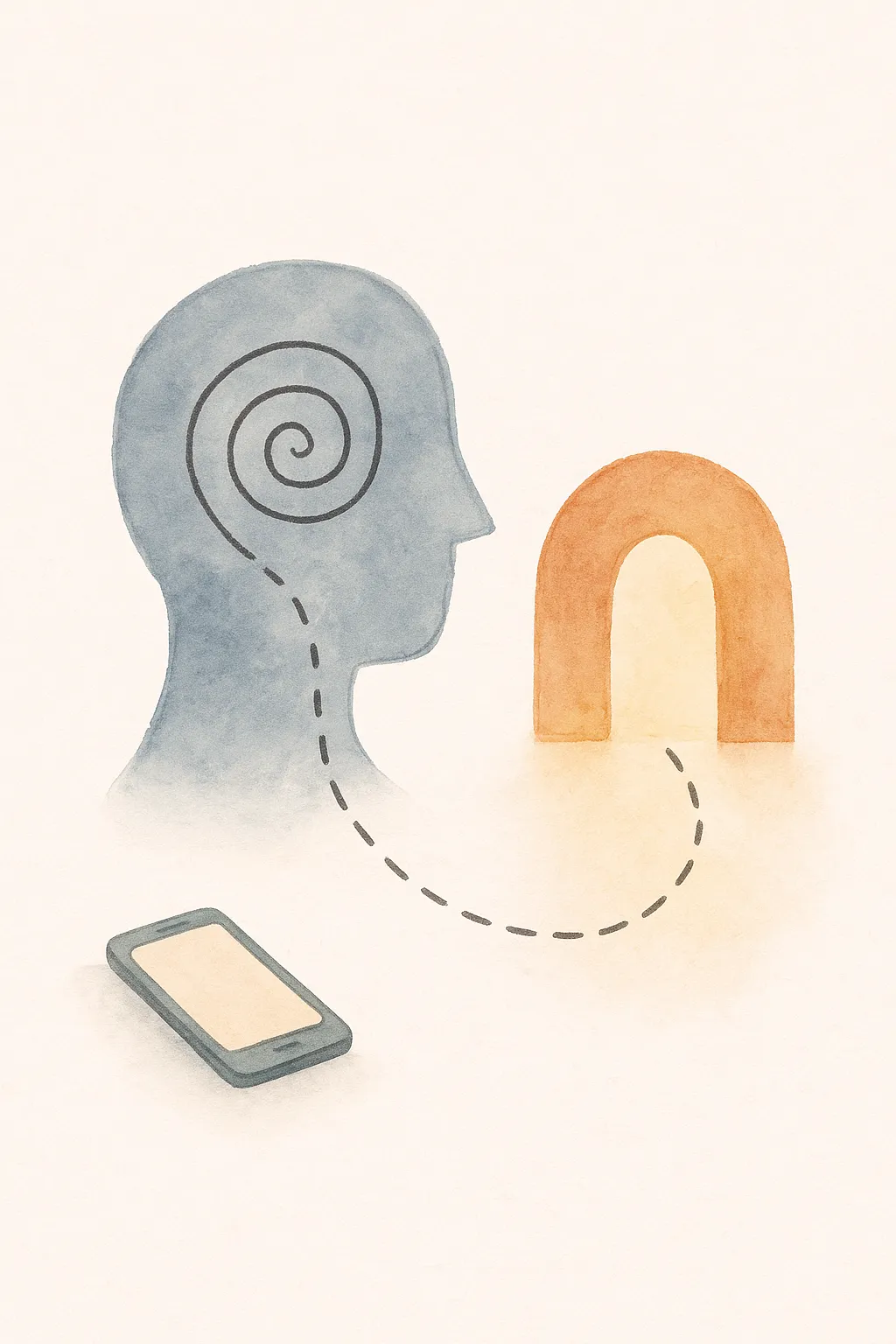
You're mid-conversation with someone you find genuinely interesting. The exchange is easy, there's a little electricity, and some part of your brain is thinking: I want them to know I'm into this. Then another part immediately fires back: but not too obviously. So you say something perfectly neutral and the moment passes, scrubbed clean of any signal at all.
That's the trap most people fall into. They treat "not being obvious" as a dimmer switch — turn the signal down low enough and you're safe. But turn it down too far and you're invisible. The real skill isn't hiding your interest. It's calibrating the signal strength so it fits the situation — legible enough that they feel something, relaxed enough that it doesn't feel like pressure.
The question is: how do you actually do that in the moment, when your brain is already running threat assessments? That's what this piece is for. By the end, you'll have a clear framework for reading the room and sending interest at exactly the right wattage.
Why Does Flirting Feel Like a Risk Even Before You've Said Anything?
Flirting feels risky before a single word leaves your mouth because your brain has already run the scenario and flagged it as a social threat. The discomfort isn't weakness or shyness — it's the result of a real cognitive pattern: most people never got explicit instruction in this skill, so the brain treats it as uncharted territory and defaults to caution.

This is where The Approach Window becomes relevant. Every potential flirtatious moment has a natural opening — a beat where the interaction could shift from neutral to something warmer. That window doesn't stay open indefinitely. Neuroscience research on decision-making suggests that if you don't act within roughly three seconds, your brain rationalizes inaction and closes the door. You don't decide not to flirt; your brain just quietly files the moment under "missed."
The anxiety usually isn't about the words themselves. It's about the gap between thinking about acting and actually acting. A lot of people spend that gap running worst-case simulations — they imagine the other person recoiling, the awkwardness, the social cost. By the time the simulation finishes, the window is gone. The good news: this is a timing problem, not a personality problem. Timing is trainable.
If you want to go deeper on the mechanics of why this freeze happens, how to overcome approach anxiety breaks down the specific cognitive loop and how to interrupt it. But for now, the key insight is this: the risk you feel before speaking is almost always larger than the actual risk. The gap between perceived threat and real threat is where the skill lives.
What Actually Makes a Signal Feel Subtle Instead of Obvious or Invisible?
Subtlety in flirting isn't about what you say — it's about the ratio of warmth to expectation. A signal feels obvious when it carries implicit pressure: I've shown interest, now you must respond to that interest. A signal feels invisible when it's so diluted that it reads as plain friendliness. The sweet spot is warmth without demand.
Concretely, this plays out in three channels: eye contact, pacing, and specificity. Holding someone's gaze half a beat longer than a neutral conversation requires costs you nothing and communicates a lot. Slowing your speech slightly when talking directly to them — not performatively, just a fraction — signals that you're present with them specifically, not just talking at the room. And specificity is probably the most underused tool: noticing something genuinely particular about them ("that's a very specific opinion about airport coffee and I respect it") signals attention without announcing attraction.
Here's what that looks like in a text exchange, where the same principles apply:
Compare that to something like "you're so cute when you talk about coffee" — which announces the attraction explicitly and puts the other person in a position where they have to respond to it. One opens a door. The other puts someone on the spot. Flirting in person follows the same logic: the signal should invite, not demand.
How Can You Send Clear Interest Without Tipping Into Obvious Territory?
The clearest framework here is thinking in layers. Your first layer is attention — you're simply more engaged with this person than with the general conversation around you. That alone reads. The second layer is light warmth: a genuine smile that lingers slightly, a follow-up question that goes one level deeper than polite. The third layer is a single, low-stakes signal that's slightly warmer than the situation requires — a compliment on something specific, a callback to something they said earlier, a moment of light teasing.
You don't need all three layers at once. In fact, stacking them all in the first five minutes is exactly what tips a subtle signal into an obvious one. The skill is deploying them sequentially, letting each one land before adding the next. Think of it less like a declaration and more like a conversation with its own tempo.
Teasing is worth its own mention because it's one of the most effective low-pressure signals when used correctly. It works because it implies familiarity — you're comfortable enough with this person to give them a hard time about something small. The key is that the tease has to be genuinely playful, not a veiled critique. "You alphabetize your bookshelf, don't you" lands differently than "you seem like you'd be really uptight about things."
Before you read on — what would YOU write here?
Someone you're into just said: "I'm terrible at making decisions, I spent 20 minutes choosing between two identical sandwiches." Take 10 seconds and draft a reply that signals interest without stating it directly. Then compare with the example below.
This is exactly the kind of scenario the Practice mode in Dating Coach is built for — running real exchanges until the calibration becomes instinctive rather than calculated. Expressing interest without seeming desperate is the same skill from a slightly different angle, and worth reading alongside this.
Pick one upcoming social situation — a work coffee, a class, a bar — and identify one specific Approach Window you'll commit to entering.
- Before you go, write down one specific observation you could make about this person (something you've noticed, not a generic compliment) — this is your layer-one signal ready to deploy.
- When the window opens, act within three seconds. Say the observation out loud, then stop. Don't add a qualifier or walk it back.
- Notice what actually happens versus what you predicted would happen. The gap between those two things is the data.

What Are the Traps That Turn Low-Key Flirting Into Mixed Signals?
The most common trap is inconsistency — being warm in one interaction and then pulling back sharply in the next because you got nervous. From your side, it feels like self-regulation. From their side, it reads as hot-and-cold, which is genuinely confusing and often reads as disinterest or game-playing. If you've ever wondered why someone seemed to lose interest after a promising start, this is frequently the mechanism.
The second trap is over-relying on ambiguity as a safety net. Some people stay deliberately vague because it feels lower-risk: if they never quite signal interest, they can never quite be rejected. The problem is that ambiguity doesn't protect you — it just delays the outcome while creating exactly the kind of mixed signals that make the other person give up and move on. If you're dealing with the receiving end of this pattern, how to deal with mixed signals is a useful read.
A third trap is letting the approach window close repeatedly and then overcorrecting. You've been neutral for four conversations, and now you feel like you need to make a move that compensates for all that time — so you go bigger than the situation warrants and it lands as obvious or intense. The fix is simpler than it sounds: small signals, consistently. You don't need to make up for lost time. You just need to start now.
Timing also matters in the text version of this. Responding to everything instantly, then going silent for hours, then sending a long message at midnight — that's not strategic mystery, that's noise. Showing interest without being too obvious over text is a calibration problem, and consistency is 80% of the solution. Keep the signal steady and let it build naturally.
How Do You Know If Your Subtle Signals Are Actually Landing?
The clearest indicator is whether they start mirroring the energy back. If you slow down, do they slow down? If you make a specific observation, do they respond with one of their own? Mirroring is largely unconscious — people do it when they're engaged and comfortable, not when they're politely waiting for the conversation to end. It's one of the more reliable signs of attraction to watch for in real time.
Another signal: they start generating reasons to extend the interaction. They ask a follow-up question when they could have let the conversation close. They bring up something you mentioned earlier. They find a reason to text when there's no logistical need to. None of these are definitive on their own, but together they suggest your signals are landing and they're reciprocating. How to tell if someone likes you goes deeper on reading these patterns without overanalyzing them.
What you're not looking for is certainty. Subtle flirting, by design, doesn't produce a clear declaration from the other side — that's the whole point. What you're looking for is engagement: are they leaning in or pulling back? That's enough information to decide whether to add another layer or hold where you are. This is also where the Approach Window framework comes back in — not just for the opening move, but for every small escalation. Each moment of slightly warmer signal has its own window, and waiting too long to add the next layer has the same effect as waiting too long to start.
If you're consistently getting warm responses but nobody's moving things forward, the bottleneck is usually the transition — and asking someone out without it being awkward can help you close that gap.
The honest answer to "are my signals landing?" is: you'll know within two or three interactions if you're paying attention to engagement rather than looking for a verdict. Most people look for a verdict — a clear sign that the other person likes them back — and miss all the softer evidence that's already there.
Flirting without being obvious isn't about suppressing your interest. It's about matching the signal to the moment — enough warmth that they feel it, calibrated well enough that it doesn't feel like a demand. That's the reframe that changes everything: you're not hiding, you're adjusting the volume for the room you're in.
The more you practice this, the more it stops being a calculation and starts being a read. You'll start noticing the windows as they open. You'll start trusting that a well-placed observation does more work than a direct declaration. And you'll stop confusing "not being obvious" with "not being interested" — because those are completely different things, and knowing the difference is what makes the skill click.