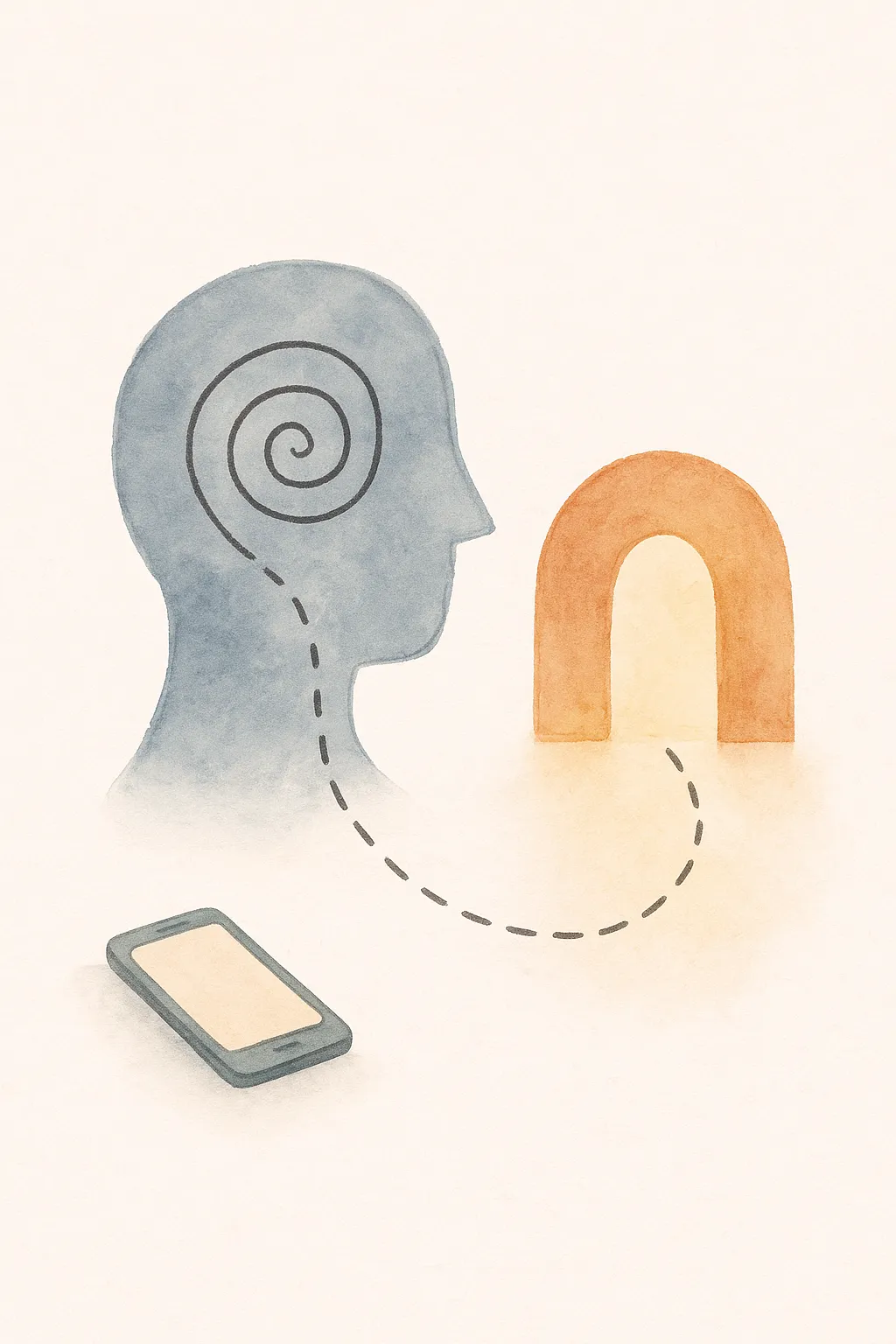
You spot them across the room — or you're three texts deep into a conversation that's actually going somewhere — and you feel it: the pull to say something that makes it clear you're interested. Then immediately, a second voice kicks in. Don't seem too keen. Don't text back too fast. Don't say that, it sounds desperate. So you hedge, you wait, you water down the message until it means almost nothing.
Here's what's actually happening in that moment: you're not revealing some unattractive truth about yourself. You're miscalibrating. The signal you're sending is either too loud or too quiet — not because you're a desperate person, but because nobody taught you how to tune the dial. Expressing interest is a calibration skill, and like any skill, it can be practiced and improved.
The question isn't "how do I hide how I feel?" It's "how do I express exactly the right amount of interest — enough to be clear, not so much that it overwhelms?" That's a very solvable problem. Here's how to solve it.
Why Does Expressing Interest Feel Like a Risk of Looking Desperate in the First Place?
Expressing interest feels risky because it creates an information asymmetry: you've revealed something about yourself before knowing how they feel. That gap — between what you've shown and what you don't yet know — is where the fear of looking desperate lives. It's not a character flaw. It's a rational response to social uncertainty that almost everyone experiences.

The deeper issue is that most people conflate intensity with desperation. They're not the same thing. Desperation is a pattern of behavior driven by anxiety — following up three times with no response, over-explaining your interest, reshaping your personality to fit what you think they want. Honest interest is just... saying the true thing at the right moment. One is a calibration error. The other is just communication.
A lot of people develop this fear after one bad experience where they expressed interest and it went badly — a rejection that felt humiliating, or a situation where they came on strong and watched the other person pull away. Your brain logged that as "showing interest = dangerous" and has been overcorrecting ever since. That's a learned response, not a permanent truth about how you operate.
This is also where approach anxiety tends to do the most damage — not in the moment of approaching, but in the internal editing that happens before you say or send anything real. You talk yourself out of clarity before you even open your mouth.
What Is the Approach Window and How Does It Change the Way You Signal Interest?
There's a concept worth understanding before you do anything else: The Approach Window. The idea is simple but the implications are significant. When a moment opens — you lock eyes, the conversation hits a natural beat, you feel the impulse to say something real — you have roughly three seconds before your brain starts generating reasons not to. After that, the window closes. Not forever, but for that specific beat. You've now missed the natural moment, and anything you say after that feels slightly off-tempo.
This matters for expressing interest because most of what reads as "desperate" isn't the content of what you said — it's the timing. Saying "I'd love to see you again" at the end of a great date lands completely differently than texting the same thing four hours after they've gone quiet. Same words, different calibration. The Approach Window is what makes the first version feel natural and the second version feel like you're chasing.
When you act inside the window, you're expressing interest as a response to a real moment. When you act after it closes — usually because you spent too long second-guessing — you're expressing interest as a response to your own anxiety. The other person can feel that difference even if they can't name it. This is exactly the kind of scenario the practice mode in Dating Coach is built for: learning to recognize the window and move inside it before the internal editor takes over.
Practically, this means training yourself to act on the first clear impulse rather than the fifth. Not impulsively — with intention. If you want to say "I'm really enjoying this conversation," say it when you first think it, not after you've rehearsed it twelve times and it's started to feel weird. Approaching someone you like gets easier when you stop treating every signal as something that needs to be optimized before delivery.
How Do You Calibrate the Right Amount of Interest Without Underselling or Overdoing It?
Calibration isn't about playing it cool. It's about matching the energy of the current moment — not the energy of where you want things to go. That distinction matters. If you're two dates in and you're already texting like you've been together for a year, you've jumped ahead of the actual relationship. That gap is what reads as desperate, not the interest itself.
A useful mental model: think of interest as a dial, not a switch. Most people either go full-on or shut down completely. The skill is in finding the setting that's one notch above where things currently are — enough to move things forward, not so much that you're pulling the other person into a dynamic they haven't signed up for yet.
Before you read on — what would YOU write here?
You've just had a first date that went well. They haven't texted yet. You want to reach out. Take 10 seconds and draft what you'd actually send. Then compare with the example below.
Compare that with the version where you send three separate messages — "that was fun," then "I really liked talking to you," then "let me know if you want to hang again" — all within twenty minutes. The content is almost identical. The calibration is completely off. Texting first without seeming desperate is mostly about this: one clear message, not a stream of them.
Identify one upcoming Approach Window — a conversation, a date, or a moment where you know you'll want to express interest — and commit to acting inside it.
- Write down the specific situation: who, where, and roughly when it will happen.
- Draft the one thing you want to say or send — keep it to a single, clear sentence that lands one notch above where things currently are.
- Set a rule for yourself: if the window opens, you say it within three seconds of recognizing it. No editing, no waiting for a better moment.

What Behaviors Actually Read as Desperate — and Which Ones Are Just Honest?
Let's get specific, because this is where a lot of people get it wrong. The behaviors that actually read as desperate are almost always about anxiety management — doing something to relieve your own discomfort rather than to genuinely connect with the other person. Double-texting after silence, over-explaining why you said something, walking back a compliment because it felt vulnerable, asking "are you mad at me?" after a normal gap in conversation. These behaviors signal that you need reassurance more than you want connection.
Honest interest looks different. Saying "I like spending time with you" is not desperate. Asking someone out directly is not desperate. Telling them you had a good time is not desperate. These are clear, single signals delivered without the need for immediate confirmation. They express something real and then let it land — without chasing the response. Flirting in person works on exactly this principle: you say the thing, you let it hang in the air, you don't immediately qualify it.
The tell is usually what comes after the signal. If you express interest and then immediately start monitoring — refreshing the conversation, reading into every delay, sending a follow-up to "make sure they saw it" — that's the anxiety talking, not the interest. Overthinking texts is often just anxiety management dressed up as strategy. Learning to send the message and genuinely move on is its own skill.
One more contrast worth making: persistence and desperation are not the same thing. Asking someone out once, getting a soft no, and asking again a few weeks later in a different context — that's persistence. Asking someone out, getting a soft no, and immediately asking "why not?" or sending three more messages explaining yourself — that's desperation. The difference is whether you're respecting the other person's response or trying to override it.
How Do You Know If You Expressed Interest Well, Regardless of How They Responded?
This is the question most people never ask — because they're too busy measuring success by the response they got. But the response is only partly in your control. What's fully in your control is whether you expressed interest clearly, calmly, and at the right moment. That's the actual skill. The outcome is data; the execution is the thing you can improve.
You expressed interest well if: you said something specific and true (not vague and hedged), you said it at a natural moment rather than after a long silence driven by nerves, and you didn't immediately walk it back or over-explain it. That's it. That's the whole rubric. Whether they said yes, went quiet, or needed time — none of that changes the quality of what you did.
This is where improving at talking to people you like actually happens — not in the outcome, but in the review. After the moment, ask yourself: did I say what I actually meant? Did I say it when I meant it, or did I wait until it was slightly too late? Did I stay calm after I said it, or did I start chasing the reaction? Those three questions will tell you more than any outcome will.
The Approach Window applies here too. If you look back and realize you waited too long — that you had three clear moments to say something and you let all of them pass — that's useful information. Not a reason to be hard on yourself, but a signal that the skill to build is acting earlier, not crafting better words. The words are almost never the problem. Approaching someone without it being awkward gets dramatically easier once you stop rehearsing and start moving.
And if you're on the other end of a situation that went quiet after you expressed interest — if they've pulled back or gone cold — that's worth understanding separately. Telling if someone is losing interest is a different skill from expressing your own, and conflating the two is how people end up either over-pursuing or shutting down entirely.
The shift that makes all of this click is simple: stop asking "did I seem desperate?" and start asking "did I calibrate accurately?" One question is about your image. The other is about your skill. Only one of them is actually in your control, and only one of them gets better with practice. You're not trying to hide what you feel — you're learning to express it at the right volume, in the right moment, without needing the response to confirm that you did it right.
When you practice this consistently — not just reading about it, but actually entering the windows, sending the clear messages, and reviewing your execution rather than the outcome — something changes. Expressing interest stops feeling like a risk and starts feeling like a tool. You know how to use it. That's the difference between hoping things go well and actually knowing what you're doing.