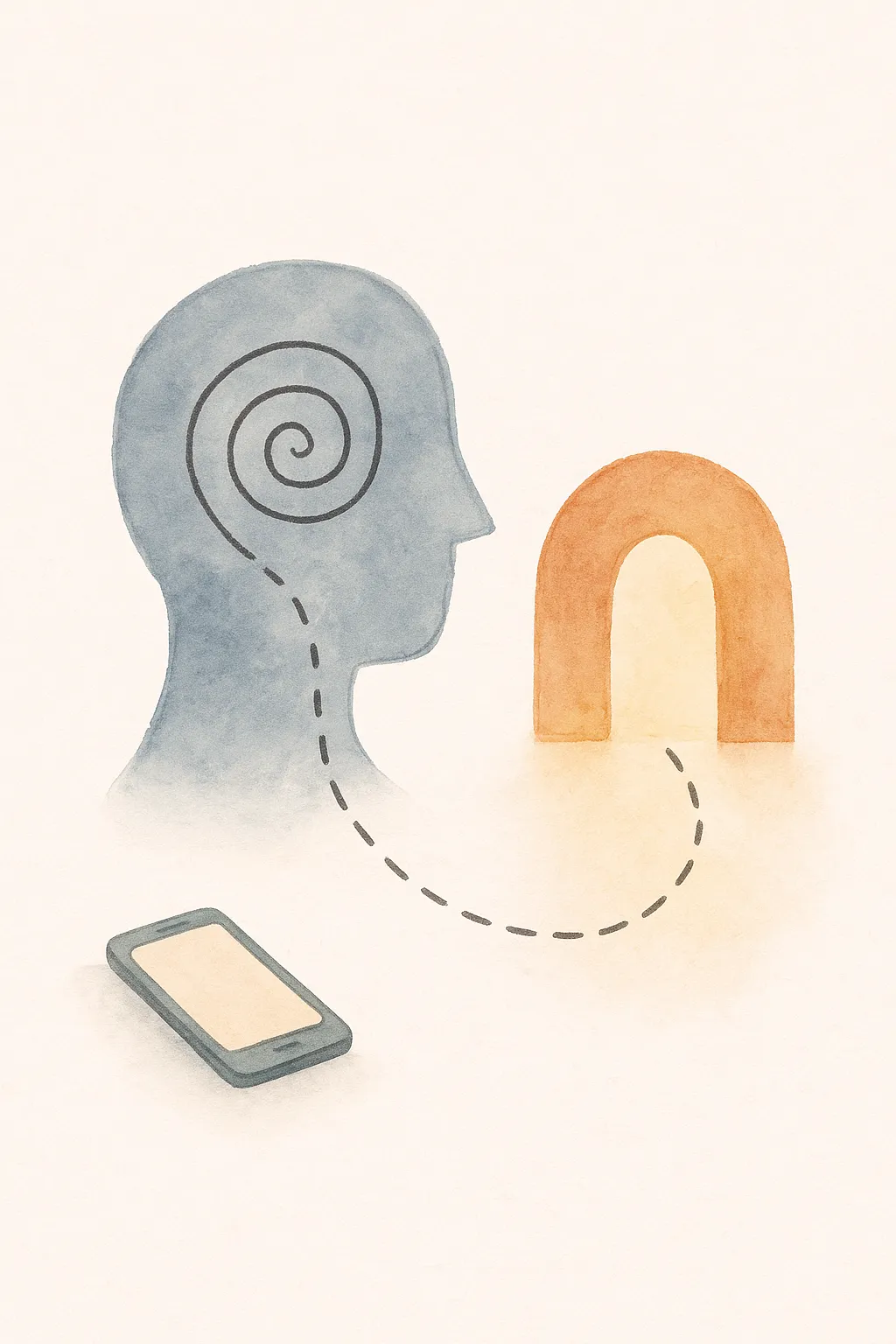
You spot someone across the room. There's a pull — you want them to know you're interested, but the moment you try to signal it, something short-circuits. Either you freeze and give nothing away, or you overcorrect and come on so strong that you watch their expression shift. The conversation ends, you replay it, and you tell yourself you're just "too much" or "too shy." Neither diagnosis is right.
The real problem isn't the volume of your interest. It's the calibration. You already have the signal — the warmth, the curiosity, the genuine pull toward this person. What nobody teaches you is how to dial it to the right frequency. Too quiet and it reads as indifference. Too loud and it reads as pressure. The sweet spot exists, and it's a learnable setting, not a personality trait you either have or don't.
So the question isn't "how do I hide how interested I am?" It's "how do I transmit interest at exactly the intensity that invites them in?" That's what this article is about. And it starts with understanding why this feels so hard in the first place — and a specific window that keeps opening and closing whether you're ready or not.
Why Does Showing Interest Feel Like an All-or-Nothing Risk?
Showing interest feels risky because most people have never been taught the middle range. They learned about interest through movies (grand gestures) and rejection (silence or awkwardness), which leaves the brain with a binary map: go big or go invisible. Neither of those is actually the skill.

The other piece is timing. There's a concept worth naming here: The Approach Window. It's the brief moment — usually just a few seconds — when the social context is open and an approach feels natural. After about three seconds of hesitation, your brain starts generating reasons not to act. The window doesn't slam shut forever, but it does close, and reopening it takes significantly more effort. Most people feel this as a sudden wave of "it's too late now" — and that feeling is real, even if the logic behind it isn't.
The all-or-nothing sensation is partly a product of that closing window. When you feel the moment slipping, the temptation is to either lunge (say something, anything) or retreat completely. Both responses are anxiety-driven, not calibration-driven. Overcoming approach anxiety isn't about eliminating the feeling — it's about recognizing the window and stepping through it with a measured signal, not a flood or a silence.
A lot of people assume that if showing interest feels scary, it means the stakes are too high, so they should feel less. That's backwards. The fear is just your nervous system flagging novelty. The actual skill is acting within the window before the flag becomes a stop sign. Once you understand that, the all-or-nothing framing starts to dissolve.
How Does the Calibration Scale Help You Signal Interest at the Right Intensity?
Think of your interest signal on a scale from 1 to 10. A 1 is pure neutrality — you could be talking to anyone, about anything. A 10 is "I've been thinking about you constantly and I need you to know that right now." The target zone for early-stage interest is roughly 4 to 6. Warm, specific, slightly elevated — but not overwhelming.
Calibration means consciously choosing where on that scale you're operating, rather than letting anxiety choose for you. Anxiety tends to push you to the extremes — either suppressing everything (landing at 2) or overcorrecting after suppression (landing at 9). Neither reflects your actual interest level. Both confuse the other person.
The practical way to use this scale is to match and then slightly exceed the energy the other person is giving. If they're relaxed and chatty, a 5 or 6 from you lands perfectly — it's noticeable, warm, and not alarming. If they're more reserved, start at a 4 and see what they do with it. Flirting in person works the same way: it's a gradual dial, not a switch.
Here's a concrete example. You're at a friend's gathering and you've been talking to someone for ten minutes. A calibrated 5 might sound like: "I'd actually like to keep talking — do you want to grab a drink over there?" That sentence does three things: it signals interest (I want more of this), it gives them agency (do you want to), and it stays proportionate (it's a drink at a party, not a declaration). Compare that to either saying nothing and drifting away, or blurting out "I feel like we have a real connection." Same interest, wildly different frequency.
What Specific Behaviors Show Genuine Interest Without Telegraphing Desperation?
The behaviors that land in the right zone all share one quality: they're specific to the person, not generic to "someone I like." Generic interest (complimenting appearance, asking what someone does for work, laughing at everything they say) reads as performance. Specific interest — referencing something they actually said, asking a follow-up that only works because you were listening — reads as real.
Remembering a detail and bringing it back is one of the most underrated moves in early dating. If someone mentioned they're trying to learn to cook, and you text them two days later with "did the pasta attempt survive?", that's a 5 on the calibration scale. It says: I was paying attention, I thought about you, I'm curious about your life. That's interest without desperation because it's low-stakes and specific, not heavy with implication.
Approaching someone you like in person follows the same logic. Eye contact held a beat longer than neutral — not a stare, just a moment — combined with a genuine smile signals interest without a word. Then, when you do speak, asking something that shows you noticed them specifically (not a generic opener) reinforces that the interest is real, not scattered.
Body language calibration matters here too. Turning slightly toward someone, mirroring their pace in conversation, not checking your phone — these are all low-frequency signals that accumulate. None of them individually screams "I like you," but together they create a warmth that the other person feels without being able to point to any single moment. That's the zone you're aiming for.
Before you read on — what would YOU write here?
You matched with someone who mentioned in their profile that they just moved to a new city. You want to show genuine interest without opening with a generic "how are you settling in?" — take 10 seconds to draft something, then compare with the example below.
Practice identifying and entering an Approach Window in a low-stakes setting this week.
- Pick one upcoming situation where you'll be around someone you find interesting — a class, a coffee shop, a social event. Before you arrive, decide you will say one specific, genuine thing within the first three seconds of a natural opening (not a rehearsed line — just a real observation or follow-up question).
- When the window appears, count to yourself: one, two — and act before three. Don't evaluate the outcome yet. The goal is just entering the window.
- After, notice how it felt compared to times you let the window close. This is exactly the kind of scenario the practice mode in Dating Coach is built for — you can run the same situation repeatedly until the three-second response feels automatic.

How Do You Avoid the Two Traps: Overclaiming and Underclaiming?
Overclaiming is when your signal is too intense for the stage of connection you're actually at. Telling someone on a second date that you've been thinking about them all week, or texting three times before they've replied once — these aren't wrong because interest is wrong. They're wrong because they skip calibration steps and put pressure on the other person to match an intensity they haven't built to yet.
Underclaiming is the less-discussed trap, but it's just as common. This is when you suppress your interest so thoroughly that the other person genuinely can't tell you like them. They assume you're being friendly. They don't feel the pull. And then you wonder why things stayed platonic. Expressing interest without seeming desperate is a real skill, but the answer is never to express no interest at all.
The way out of both traps is to treat each interaction as its own calibration moment rather than a single high-stakes performance. If you overclaimed last time — texted too much, came on too strong — you don't need to swing to the opposite extreme. You just dial back one notch. If you underclaimed — gave nothing, stayed purely neutral — you don't need to confess everything. You just add one specific, warm signal. Small adjustments, not full reversals.
Watch for the pattern of overthinking texts as a sign you're in overclaim territory. When you're drafting and re-drafting a message trying to get it perfect, you're usually trying to manage how much you're revealing — which means your signal is already running hot. The fix isn't a perfect message. It's dropping back to a genuine, proportionate one.
How Do You Know When Your Interest Level Is Landing — and What to Do Next?
Interest is landing when the other person starts matching or slightly exceeding your energy. They ask a follow-up question. They remember something you said. They initiate contact. These are all signs that your signal registered at the right frequency — they felt the warmth without feeling the pressure. Reading the signs that someone likes you is partly about noticing this reciprocity.
If your interest isn't landing, there are two possibilities: either the calibration is off (too much or too little), or the interest genuinely isn't mutual. The way to tell the difference is to try one small dial adjustment and see what changes. Add one specific, warm signal and observe. If they respond with more energy, you were underclaiming. If they pull back slightly, you may have been overclaiming — or the interest isn't there, and that's useful information too.
The Approach Window matters here as well. Once you've established some connection, there are windows to escalate — to suggest a date, to ask for a number, to say something a little more direct. Those windows follow the same logic: they open, they close, and hesitating too long turns a natural moment into an awkward one. Asking someone out without it being awkward is mostly about acting within the window rather than waiting until you're certain — certainty rarely comes before you act.
When you're ready to move things forward, the language stays calibrated. "I'd like to see you again" is a 6. "I can't stop thinking about you" is a 9. Both might be true, but only one is appropriate for the moment. Knowing how to read whether someone is interested after a date gives you the context to choose the right dial setting for your next move — their energy after you part ways tells you more than anything they said during.
What to do next is almost always: one small, specific move in the direction of more connection. Not a declaration. Not a strategy. Just the next natural step at the right frequency. That's the whole skill.
You already have the interest. You already have the signal. The calibration problem is much more solvable than a personality problem — it's just a matter of reps. Getting better at talking to people you like is the same process: you practice the dial, not the feeling.
The shift that happens when you internalize this is quiet but real. You stop treating every interaction as a pass/fail test of how likeable you are, and start treating it as a calibration session. You showed interest, you watched how it landed, you adjusted. That's not rejection waiting to happen — that's skill building in real time.
When you practice this consistently, something else changes too: you stop being so afraid of the windows. Because you know that even if this one closes, you'll recognize the next one. And the one after that. The frequency is always adjustable. That's the whole point.