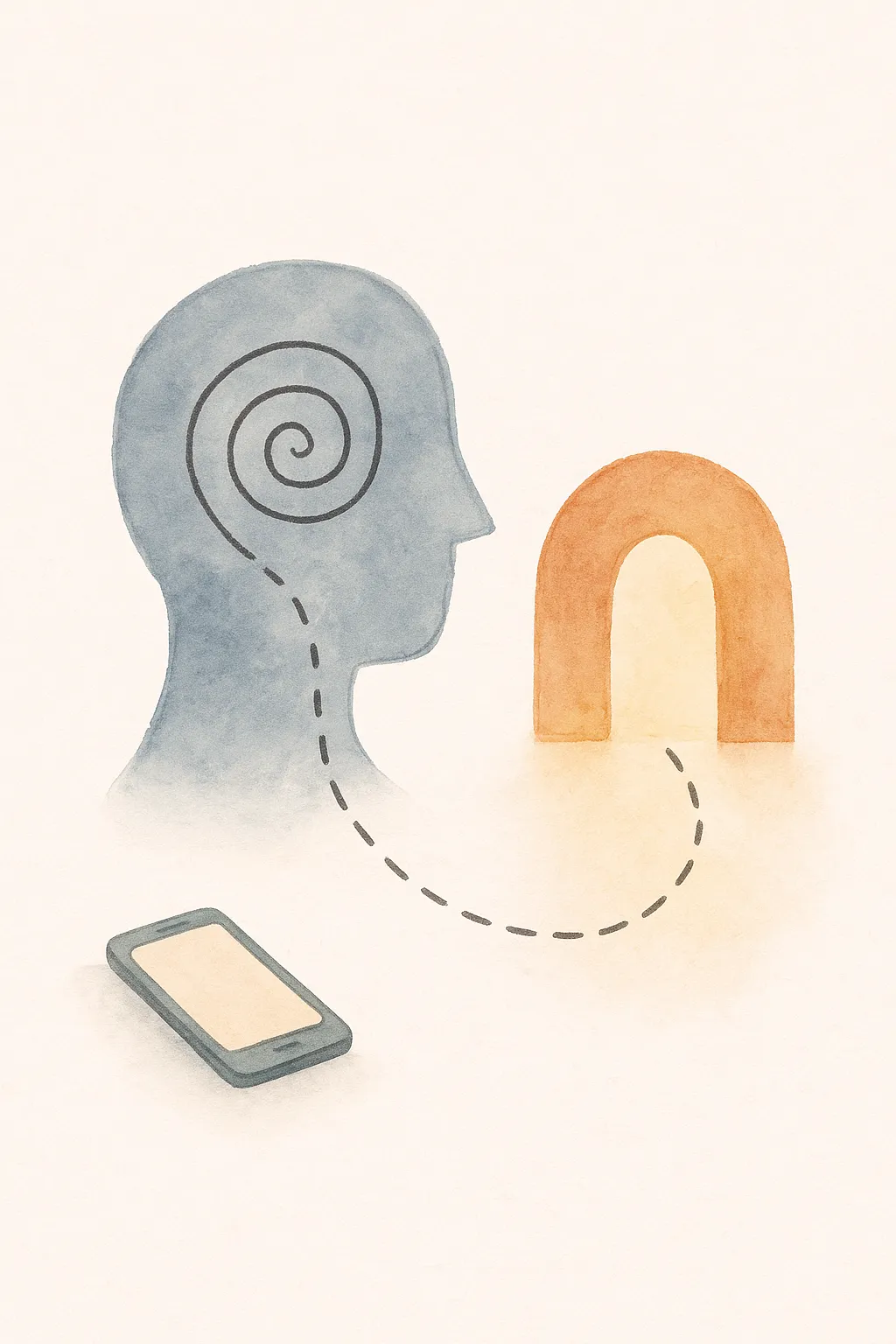
You send the text. Then you put your phone face-down, pick it up, put it down again, check it, tell yourself to stop checking it, and check it one more time. Not because you're desperate — but because somewhere along the way, you trained yourself to use their reply as a signal about whether you're okay. That's not a character flaw. That's a feedback loop you accidentally built, and it runs on autopilot until you deliberately interrupt it.
The tricky part is that the loop feels rational in the moment. Dating involves real uncertainty, real stakes, real people who might not like you back. Of course you want signals. The problem is when those signals stop being useful information and start being the only thing keeping your confidence afloat. At that point, you're not dating — you're auditing yourself through someone else's eyes.
So how do you stop outsourcing your self-worth to someone who doesn't even know your last name yet? That's exactly what this breaks down — not with reassurance, but with a concrete method for retraining the loop from the outside in.
Here's the frame that makes this make sense: confidence isn't what you need before you start. It's what you build after you practice. The Confidence Loop works like this — you develop a skill, you practice it, you get a small win, and confidence grows from that. It's an output, not a prerequisite. Validation-seeking is what happens when you skip the loop and try to borrow confidence from someone else's reaction instead. The good news: loops can be retrained. That's the whole point of this.
Why Does Dating Make You So Dependent on Someone Else's Approval?
Dating activates approval-seeking because it combines two things that reliably destabilize people: genuine uncertainty about outcomes and genuine vulnerability about identity. Your brain reaches for any available signal — and the most available one is their behavior toward you. Over time, you learn to read their responses as feedback on your worth, not just on compatibility.
This happens faster than people realize. A few interactions where a great reply made you feel good and a slow reply made you spiral, and your nervous system has logged the pattern: their response = your value. You didn't choose this. You just repeated the experience enough times that it became automatic. That's how feedback loops form — not through weakness, but through repetition.
The reason dating specifically accelerates this is that it's one of the few adult contexts where rejection is both personal and unpredictable. At work, you usually know the criteria. In friendships, there's history. Dating has neither — which means your brain fills the gap with whatever feedback is available. Usually, that's their text reply speed, their tone, whether they suggested a second date. None of these things actually measure your worth. But your nervous system treats them like they do.
Nobody teaches you how to hold your own approval steady while someone else's is uncertain. That's not a personal failing — it's a gap in what most people ever learn about building confidence in dating. The skill exists. It just has to be practiced deliberately.
How Does the Validation Loop Actually Keep You Stuck in Anxious Dating Patterns?
The validation loop has a specific structure that makes it self-reinforcing. You feel uncertain, so you seek a signal. The signal arrives (or doesn't), which produces temporary relief (or anxiety). Either way, you've just confirmed that the signal matters — so next time, you seek it even harder. The loop doesn't just maintain the problem. It deepens it.
Here's what this looks like in practice. You go on a date that feels good, and instead of sitting with that feeling, you immediately start analyzing whether they had a good time too. You check for texts. You replay moments. You overthink everything after the date not because you're irrational, but because you've trained yourself to treat their approval as the verdict on the whole experience. Your own read on it barely registers.
The anxious version of the loop also warps how you show up on dates. When you need someone's approval to feel okay, you start optimizing for their comfort instead of genuine connection. You agree with things you don't actually agree with. You soften opinions. You stay stuck in your head monitoring their reactions instead of actually being present. Ironically, this makes you less attractive — not because of some game-playing rule, but because people can feel when someone isn't fully there.
The loop keeps you stuck because it feels like it's managing risk. In reality, it's manufacturing anxiety. Every time you outsource your emotional state to someone else's response, you make it slightly harder to trust your own read on things. That erosion compounds quietly over months and years of dating.
What Specific Habits Build an Internal Anchor So You Stop Outsourcing Your Self-Worth?
An internal anchor isn't a mindset shift you decide to have. It's a set of practiced behaviors that gradually make your sense of self less dependent on external input. The key word is practiced — this is where the Confidence Loop becomes practical. You pick a specific skill, you practice it in low-stakes situations, you notice small wins, and confidence accretes from those wins rather than from someone else's approval.
One of the most effective habits is what you might call a post-interaction debrief — but your own version, not theirs. After a date or a significant text exchange, before you check whether they've replied or analyze their tone, write down three sentences about your own experience. What did you enjoy? What felt off? What would you do differently? This trains your brain to treat your own read as primary data, not an afterthought. It's also one of the clearest ways to stop people pleasing in dating — when you regularly check in with your own experience first, you stop reflexively shaping yourself around what you think the other person wants.
Pick one recent interaction where you caught yourself seeking validation — a text you over-analyzed, a date you replayed obsessively, a reply you waited for too anxiously.
- Write one sentence about how YOU felt during that interaction, independent of how they responded — not 'they seemed interested' but 'I felt relaxed / anxious / bored / engaged'
- Write one sentence about what you actually wanted from the interaction — not what you wanted them to think of you
- Notice the gap between those two things and your actual memory of the interaction — that gap is where validation-seeking lives

Another habit that works: set a standard for yourself before a date, not after. Decide in advance what a good date looks like from your side — not 'they like me' but 'I was curious, I was honest, I had at least one genuine laugh.' Then evaluate the date against that standard, not against their follow-up behavior. This is harder than it sounds because you've probably never been taught to do it. But it's a learnable skill, and it changes everything about how you show up on a first date.
There's also a texting version of this. Before you send a message, ask yourself: am I sending this because I want to, or because I'm hoping a certain reply will make me feel better? The former is communication. The latter is using someone as an emotional vending machine. When you catch yourself in the second mode, pause. You don't have to not send the text — you just want to know which mode you're in. Awareness is the first rep.
Before you read on — think about the last time you were left on read or got a one-word reply. What story did you immediately tell yourself about what it meant?
Take 10 seconds. Then notice: was that story about them, or about you? The answer tells you a lot about where your anchor currently sits.
How Do You Catch Yourself Mid-Spiral Before a Text or Date Derails Your Confidence?
Spirals have a signature. There's usually a trigger (a slow reply, an ambiguous comment on a date, being left without a text back), followed by an interpretation that goes straight to the worst-case personal conclusion, followed by a behavior designed to resolve the discomfort — usually more checking, more analyzing, or more reaching out. Learning to catch the spiral means learning to recognize the signature early, before the behavior kicks in.
The most useful intervention point is between the trigger and the interpretation. When you notice you're about to assign meaning to something ambiguous — their reply took four hours, they said 'sounds good' instead of 'can't wait' — ask yourself one question: what's the most boring explanation for this? Not the best-case, not the worst-case. The most boring. Usually it's 'they were busy' or 'that's just how they text.' The boring explanation is almost always the accurate one.
If you're prone to reading into texts or replaying dates for hidden meaning, it helps to have a physical interruption — something you do with your body that breaks the mental loop. Go for a walk, make something with your hands, call a friend about something completely unrelated. This isn't avoidance. It's giving your nervous system a chance to reset before you make decisions from an anxious state. The spiral can't survive a genuine interruption. People who are naturally more charismatic in dating tend to have this kind of reset built in — they don't let ambiguous signals hijack their state for hours.
This is exactly the kind of scenario the practice mode in Dating Coach is built for — running through real situations and building the habit of responding from a grounded place instead of a reactive one. The more you practice catching the spiral in low-stakes moments, the faster you catch it when the stakes feel higher.
How Will You Know When You've Actually Shifted From External Validation to Internal Security?
The shift doesn't announce itself. There's no morning where you wake up and feel permanently secure. What happens instead is that you start noticing smaller things: you send a text and don't immediately check for a reply. You go on a date and come home thinking about whether you enjoyed yourself, not just whether they did. You handle rejection without it restructuring your entire self-concept for a week. These aren't dramatic changes. They're just signs that your anchor has moved inward.
One concrete marker: you start having opinions about people you're dating, not just about whether they like you. When you're deep in validation-seeking mode, the person in front of you barely registers as a full human — they're mostly a source of feedback. When the shift happens, you start genuinely noticing whether you like them, whether you're attracted to their personality, whether you'd actually want to spend more time with them. That's not selfishness. That's what dating is supposed to feel like — and it's also what makes you more likeable in dating, because people respond to someone who's genuinely present and curious rather than quietly auditioning.
Another marker is how you relate to uncertainty. Validation-seeking is essentially an attempt to eliminate uncertainty by getting a signal from someone else. Internal security means you can tolerate not knowing — not because you don't care, but because your okay-ness isn't riding on the outcome. You can build that kind of confidence deliberately, through the same loop you've been building all along: skill, practice, win, repeat.
You'll also notice changes in who you're attracted to. When external validation is running the show, you tend to get attached to people who are unpredictable — because unpredictability keeps the validation loop firing. When you're more internally anchored, you stop finding that pattern interesting. Consistency starts to feel good rather than boring. That's a real signal that something has shifted.
The last marker is subtle but important: rejection stops feeling like a verdict. When your self-worth isn't riding on any single person's approval, their no is just information about fit, not information about you. That reframe doesn't happen through positive thinking — it happens through enough reps of surviving rejection and noticing that you're still intact on the other side. The evidence accumulates, and eventually, your nervous system believes it.
What you trained accidentally, you can retrain deliberately. The validation loop didn't form because something is broken in you — it formed because you repeated a pattern enough times that it became automatic. The Confidence Loop works the same way, just in the opposite direction: you practice the skill, you get the rep, you build the win, confidence follows. Not from a pep talk. From the work itself.
The person who practices this long enough stops asking 'do they like me?' as their first question after every interaction. They start asking 'do I like them?' That's not arrogance. That's what it feels like to show up to dating as a full person rather than an applicant. And that shift — quiet as it is — changes every conversation, every date, and every text from that point forward.